

Recent Blogs
Stay updated with our latest blog posts.

Your old heater is finally gone, but figuring out how thorough clean-up after a furnace install protects your home's air quality is the most critical step before turning that new system on. You have just invested in a major mechanical upgrade, and the excitement of reliable warmth is building. However, at Stewart Heating, Plumbing and Air Conditioning, our team often reminds customers that right after the heavy lifting stops and right before the system runs its first test cycle, a hidden risk sits inside your ductwork.
The process of removing an outdated unit—like an old 80% AFUE furnace from the early 2000s—and fitting a modern, high-efficiency system generates a significant amount of invisible construction debris. If a technician flips the power switch without executing a meticulous clean-up first, all those settled contaminants will instantly blast into your living spaces. During early fall heating prep in September 2026, this transition phase is the ultimate decision point. Ensuring your installation crew follows strict mechanical commissioning standards is the only way to safeguard your lungs.
To learn more about professional standards for heating systems, or to schedule an HVAC installation estimate, working with technicians who prioritize your air quality makes all the difference.
The problem starts with the physical reality of heavy mechanical work. Replacing a large appliance in a tight utility closet, basement, or attic—especially in older 1950s to 1980s-era Pittsburgh CA homes—is not a clean process. Technicians must dismantle old, dusty equipment and maneuver heavy new units into place, which naturally disturbs years of settled dirt.
The core cause of this debris comes down to the necessary modifications required to connect new equipment to existing ductwork. Technicians must cut custom sheet metal to build new transitions. They often have to modify fiberglass ductboard or adjust surrounding drywall to ensure proper clearances. These actions generate very specific, highly irritating contaminants. You are not just dealing with normal household dust. The work area quickly fills with respirable fiberglass insulation shards, fine metal shavings, and heavy drywall dust.
Common installation contaminants include:
• Sheet metal shavings: Tiny, sharp flakes created when customizing the plenum to fit the new furnace.
• Fiberglass shards: Microscopic threads from cut insulation that easily become airborne and irritate the lungs.
• Drywall and sawdust: Fine powders that coat internal sensors, blower wheels, and eventually your furniture.
• Old accumulated debris: Years of trapped dirt knocked loose during the dismantling of the old unit.
Because the ductwork is wide open during these modifications, these heavy particulates naturally fall directly into the exposed air stream pathways. The Environmental Protection Agency (EPA) notes that indoor air can already be two to five times more polluted than outdoor air. Adding construction debris to the mix during early fall heating prep severely worsens that baseline.
The solution requires acknowledging that source control is the most effective way to manage indoor air pollution. Installers must treat the immediate work zone as a controlled environment. By containing the dust at the source and immediately addressing the fallout from cutting metal and drywall, technicians prevent these heavy particulates from migrating deeper into the labyrinth of your home's ventilation system.
The return drop and the supply plenum serve as the central hubs for your home's air distribution. The return drop pulls air from your rooms into the furnace, while the supply plenum pushes the freshly heated air back out. If these critical junctions are not spotless, your entire house suffers.
Any debris left sitting in the return drop poses an immediate threat to the equipment. Heavy dust and metal flakes will either bypass standard filters entirely or prematurely clog a brand-new filter on day one. On the supply side, the danger shifts to your family. Fiberglass threads and metal dust left resting in the supply plenum have a direct, unhindered path into your living spaces.
One local homeowner recently reached out to our Stewart Heating installation crew for an early fall upgrade to a high-efficiency variable-speed furnace. Because our technicians arrived early and meticulously covered the work area, they were able to properly clean up the plenums and duct boots afterward. By the time they explained the system's operation to the customer, the air path was completely clear of construction debris. This level of care is essential for Pittsburgh CA homes.
The moment the blower motor engages for the first time is the most vulnerable point in the installation process. High-velocity air—often pushed by a powerful 1200 CFM blower motor—rushes through the newly connected pathways. This intense pressure dislodges heavy particles that simple settling alone will never move.
The critical wipe-down zones:
• The inner walls of the supply plenum: Must be wiped with a damp cloth to capture fine metal dust before the fan kicks on.
• The base of the return drop: Must be vacuumed to remove old dirt knocked loose during the swap.
• The immediate duct boots: Must be cleared of any drywall dust that fell during the transition fitting.
Vacuuming the duct boots and wiping down the internal metal of the plenums are mandatory steps in mechanical commissioning. If installers skip this, the first cycle acts as a delivery mechanism, forcefully blowing respiratory hazards through every vent in your house.
The timing of a furnace replacement plays a massive role in how severely installation dust impacts your daily life. During the summer and early fall, you might leave windows open, allowing fresh air to cycle through the house and naturally dilute indoor pollutants.
However, as we navigate the weather shifts in September 2026, homes transition away from open-window ventilation. The chilly winter nights in Pittsburg, CA, necessitate tightly sealing your home to retain valuable heat. Weatherstripping is checked, windows are locked tight, and drafts are eliminated. Modern energy-efficiency standards mean newer windows and better insulation trap air more effectively than ever before. While this is fantastic for lowering your utility bills, it creates a closed-loop system for indoor air.
Because these tightly sealed homes lack natural ventilation, they lose the ability to flush out airborne contaminants. If a careless installation crew leaves behind day-one installation dust, that debris has nowhere to go. It gets pulled into the return vents, pushed through the supply vents, and remains trapped inside the building envelope.
The solution is proactive extraction before the house is sealed for the season. For Pittsburgh CA homes, removing this debris before the first cold snap is non-negotiable. Installers must ensure the system is entirely sterile before you lock your windows for the winter. Any construction contaminants introduced during this period will otherwise recirculate all season long, settling on furniture, coating electronics, and degrading your family's respiratory health.
Many homeowners assume that if the floor looks clean, the job is done. This is a dangerous misconception. In our experience, there is a massive difference between basic janitorial cleanup and the technical, mechanical clean-up required for complex HVAC systems.
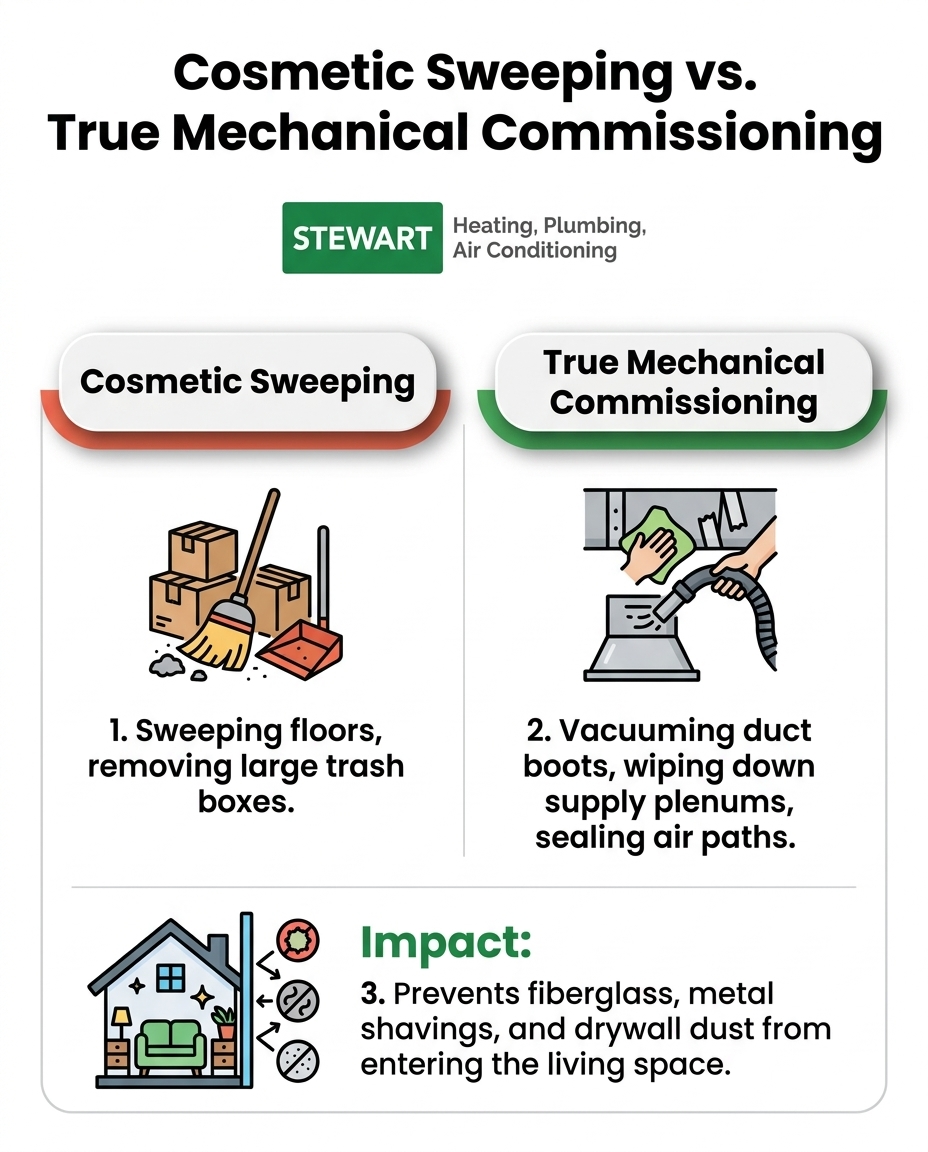
Cosmetic sweeping is exactly what it sounds like. It involves picking up large pieces of trash, hauling away the old equipment boxes, and running a broom over the immediate floor space. While a tidy workspace is nice, sweeping does absolutely nothing to protect your ductwork.
True mechanical commissioning clean-up treats the internal air path with the same respect as the electronic wiring. It involves wiping down internal metal surfaces, using high-powered vacuums on the duct boots, and ensuring a completely sealed, sterile air path. You should expect this level of rigor from any reputable installation crew during early fall heating prep. This step is not an afterthought; it is an essential safeguard for your home's respiratory health.
• Cosmetic Sweeping — Primary Focus Area: Floors, walkways, and general workspace — Tools Typically Used: Brooms, dustpans, trash bags — Impact on Air Quality: Zero. Leaves internal duct debris untouched.
• Mechanical Commissioning — Primary Focus Area: Plenums, duct boots, blower compartments — Tools Typically Used: High-powered shop vacuums, damp microfiber cloths — Impact on Air Quality: High. Prevents fiberglass and metal dust from circulating.
The way an installer treats your physical property is a direct reflection of how they handle the technical aspects of their job. An installer's approach to the physical workspace heavily mirrors their approach to the complex mechanical wiring, gas line calibration, and airflow balancing required for a new furnace.
This is why strict policies regarding heavy-duty tarps and shoe covers are so important. These tools do more than just keep mud off your carpets. They prevent cross-contamination from the outdoors to the indoors, ensuring that dirt, moisture, and exterior pollutants are not tracked into the sterile environment of your open ductwork. Protecting the home's air quality starts at the front door.
One local customer scheduled our team for the installation of a new heater and thermostat just before the winter rush. The Stewart Heating technician arrived on time, laid down protective coverings, and installed the heater while carefully instructing the homeowner on its operation. Because the job was completed professionally and the entire area was left spotless, the transition to the new system was completely seamless.
This meticulous respect for the home connects directly to the precision required for complex mechanical work. If a technician takes the time to protect your floors, they are taking the time to seal your flues and calibrate your blower motor. For more insight into this standard, read about what tarps and shoe covers say about an HVAC installer's precision. For Pittsburgh CA homes, this level of care is the baseline for a successful, safe upgrade.
Once the immediate installation clean-up is complete, your focus should shift to broader indoor air quality strategies. A pristine installation sets the perfect baseline, but maintaining that air quality requires ongoing attention. During early fall heating prep, setting up a long-term defense strategy ensures your new furnace operates at peak efficiency while keeping your family's lungs clear.
1. Check the filter after the break-in period: Even with the most meticulous mechanical clean-up, microscopic dust from the manufacturing process of the furnace itself will burn off or circulate during the first few days. Check your air filter after the first week of operation and replace it if it shows gray or white dust buildup.
2. Establish a pristine baseline: A perfectly clean return drop and supply plenum mean your standard filters can do their job without being overwhelmed by construction debris. This clean slate is required before adding any advanced purification technology.
3. Upgrade to whole-home filtration: Standard one-inch MERV 4 filters only catch large particles. Upgrading to a four-inch MERV 11 or MERV 13 media cabinet or a high-efficiency filtration system captures the fine particulates that slip through basic fiberglass screens.
4. Integrate active purification: Once source control is established, consider adding UV lamps or active air scrubbers to neutralize biological contaminants and volatile organic compounds (VOCs).
By treating the installation clean-up as step one, you pave the way for comprehensive indoor air quality solutions that protect your home year-round.
A new furnace should dramatically improve your home's comfort and air quality, not degrade it with leftover construction debris. The transition from an old, inefficient unit to a modern system is an investment in your family's well-being, and the final steps of that installation dictate how safe that transition will be.
Choosing a team like Stewart Heating, Plumbing and Air Conditioning that treats clean-up as a strict mechanical necessity—rather than a quick sweep of the broom—ensures that your early fall heating prep yields safe, breathable air. Never settle for an installation that leaves your ductwork vulnerable to metal shavings and fiberglass dust.
By prioritizing professional, meticulous care, you can enjoy the warmth of a highly efficient system without worrying about what is blowing out of your vents. Take the time to partner with experts who value your home's respiratory health just as much as its temperature, ensuring clear, technical understanding of what professional post-install clean-up truly entails.
Does a new furnace cause dust in the house?
A new furnace itself does not generate dust, but the installation process certainly can. Modifying ductwork, cutting sheet metal, and adjusting drywall create significant debris. If the installation crew does not perform a thorough mechanical clean-up before turning the unit on, this trapped construction dust will blow directly into your home.
What happens during the final stages of a furnace install?
The final stages involve critical mechanical commissioning and safety checks. Technicians will calibrate the gas pressure, test the blower motor, and verify the thermostat communication. Crucially, they must also vacuum the duct boots and wipe down the supply plenums to ensure no debris enters the air stream during the first test cycle.
How long does a new furnace smell like burning dust?
It is common for a new furnace to emit a faint burning smell for the first few hours of operation. This occurs because the protective oils used during the manufacturing of the heat exchanger are burning off safely. However, if the smell persists for more than a day, or smells distinctly like burning plastic or heavy debris, you should shut the system down and contact a professional.
Should you clean air ducts after installing a new furnace?
If the installation was performed correctly with proper source control, a full duct cleaning is not immediately necessary. A professional crew will vacuum the immediate return drops and supply plenums during the install. However, if your ducts have not been cleaned in several years, pairing a new furnace installation with a comprehensive duct cleaning provides an excellent fresh start for your indoor air quality.
Why is wiping down the supply plenum necessary before turning on a new HVAC unit?
Wiping down the supply plenum removes fine metal shavings, fiberglass shards, and drywall dust created during the fitting process. Because the supply plenum pushes air directly into your living spaces, any debris left inside will bypass your air filter entirely. Cleaning this component prevents respiratory irritants from being forcefully circulated through your home.
What specific types of debris are generated during a furnace replacement?
A standard furnace replacement generates several types of hidden debris that threaten air quality. You will typically find sharp sheet metal shavings from custom duct fittings, microscopic fiberglass threads from disturbed ductboard, and fine drywall dust from adjusting the unit's clearances. Old, accumulated dirt from the previous unit is also frequently knocked loose during the equipment swap.

Very professional and complete. I would recommend Stewart to anyone. Highest quality of workmanship and clean installation.
Stewart Heating Plumbing Air Conditioning just did some work for us for the first time. They did an installation at my home and it turned out well. I thought the price was fair and I definitely would use them again. The technicians were very friendly and knowledgeable about their work. I highly recommend Stewart Heating Plumbing Air Conditioning and already told friends to use them.
We have been using Stewart Heating Plumbing Air Conditioning since 1995. They put the original heating and air unit in the house, and we have just stayed with them. They are dependable and honest people, and they have done a good job for us every time that we have used them!
They came and did an inspection and are coming tomorrow to do the repair.
They replaced a regulator the first time, and then the water heater vent had to be replaced. They did great work.
The gentleman that serviced us was helpful, insightful, and knew what he was talking about. Overall, it was a great experience.