

Recent Blogs
Stay updated with our latest blog posts.

Your thermostat is set, the vents are blowing ice-cold air, and you feel ready for the heat, but you might still be overlooking the hidden impact of carbon monoxide detector upgrades during routine maintenance. At Stewart Heating, Plumbing and Air Conditioning, a pattern our team sees often during July service calls is that most homeowners assume a summer tune-up focuses exclusively on refrigerant levels, electrical connections, and cold air output. You expect the technician to clean the system and move on. However, this expectation misses a critical unseen hazard: your HVAC system circulates air throughout your entire house, meaning any undetected indoor air issue spreads rapidly from room to room.
For comprehensive support, explore our HVAC services or sign up for a routine HVAC maintenance plan to keep your system running safely year-round.
The concrete problem many homeowners face during the peak-summer AC maintenance season is treating cooling and safety as two separate categories. You might check your smoke alarms during spring cleaning, but summer brings its own unique risks. This brings us to a crucial decision point during a professional service visit: the moment our thorough technicians pivot from inspecting the mechanical cooling equipment to auditing your home's fire and carbon monoxide detectors. In our decades of serving the Pittsburgh area, we treat this proactive pivot as a standard of care, not an upsell. A tightly sealed home requires vigilant monitoring, and upgrading aging detectors while our professionals are already on-site ensures your living space is secure without requiring a separate service call.
To understand why a cooling visit involves checking safety alarms, you have to look at how your equipment actually functions. An air conditioner does not just create cold air out of nowhere; it continuously pulls in, filters, and redistributes the existing air inside your living space. Our technicians often tell customers to think of their ductwork as the respiratory system of the house.
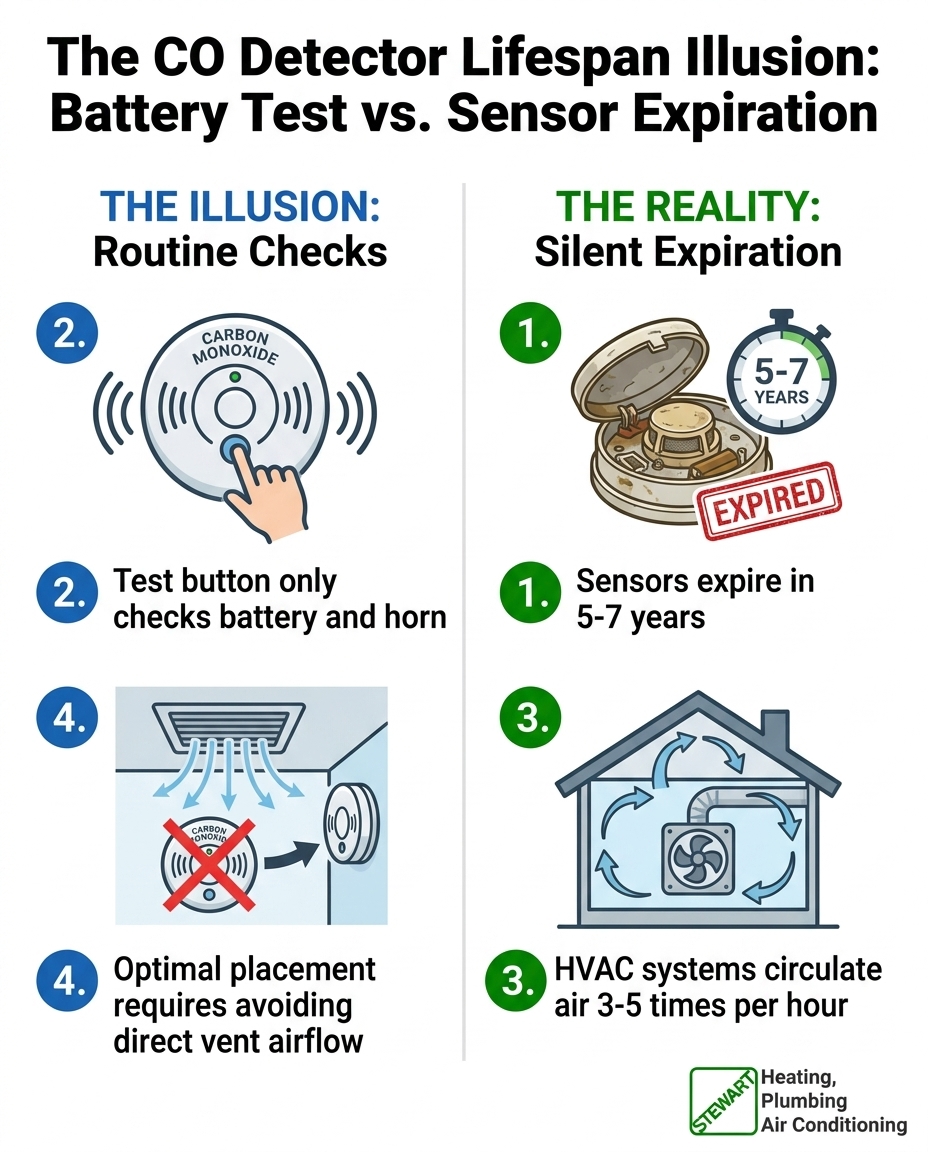
During peak cooling cycles in the intense July heat, your system circulates the home's entire air volume three to five times per hour. This rapid circulation is fantastic for keeping you comfortable, but our indoor air quality (IAQ) specialists know it presents a massive challenge for safety.
• Continuous pulling: Return vents draw air from hallways, living rooms, and sometimes near attached garages or utility closets.
• Centralized mixing: All that drawn air meets at the air handler, passing over the indoor coil.
• Widespread distribution: The blower fan forcefully pushes that mixed air back into every single bedroom and living space.
Because of this mechanical reality, a localized issue quickly becomes a whole-house hazard. If there is a small carbon monoxide leak from a gas water heater in the utility room, or exhaust seeping in from an idling car in the attached garage, your AC system will pick up those invisible gases and pump them directly into your bedrooms. Monitoring this "respiratory system" requires functional, well-placed safety devices. If you are concerned about what your system is circulating, exploring indoor air quality solutions is a vital step toward a healthier home.
Carbon monoxide is often mistakenly viewed as a threat tied exclusively to colder months. However, our team knows firsthand that summer presents a distinct and dangerous set of conditions for Pittsburgh, CA residential homes. With summer temperatures regularly exceeding 100°F in the area, homeowners are forced to keep their windows tightly closed and weatherstripping locked down to maximize energy efficiency and cooling performance under heavy loads.
This lack of natural ventilation means your house becomes a sealed envelope. Any carbon monoxide leak from year-round sources gets trapped inside with nowhere to vent.
• Ventilation — Mild Weather Conditions: Windows occasionally open, natural airflow. — Peak Summer Conditions: Windows closed, heavy insulation blocking extreme heat.
• HVAC Operation — Mild Weather Conditions: System runs intermittently. — Peak Summer Conditions: AC runs continuously under heavy load, rapidly circulating trapped air.
• Primary CO Sources — Mild Weather Conditions: Standard appliance usage with adequate venting. — Peak Summer Conditions: Gas water heaters, gas stoves, idling cars in attached garages, with zero natural ventilation.
When the house is sealed against the intense heat, a functional carbon monoxide detector becomes your only line of defense. Even when the heating system is completely shut off for the season, the everyday appliances that heat your water or cook your food can still malfunction. Without fresh air naturally diluting the indoor environment, those trapped gases accumulate much faster, making functional alarms critical during the peak of summer.
One of the most dangerous misconceptions we see homeowners hold is trusting a detector simply because it beeps when pressed. During summer AC maintenance visits, our Stewart Heating technicians frequently encounter homes protected by "ghost" alarms—devices that look fine and sound loud, but are entirely incapable of sensing danger.
Carbon monoxide detector sensors chemically degrade over time. Industry data shows that these specific sensors typically expire after 5 to 7 years. The dangerous illusion occurs because pressing the "test" button on the front of the unit only verifies that the battery has juice and the electronic horn can sound. It does not verify that the internal chemical sensor can still detect gas.
1. Removing the unit from the wall or ceiling: We safely twist the detector off its mounting bracket to access the back panel.
2. Locating the manufacture date: Our team looks for a printed date or sticker on the plastic casing.
3. Calculating the lifespan: If the date is more than 5 to 7 years old, we flag the unit as expired, regardless of whether it still beeps during a battery test.
4. Replacing the unit immediately: We ensure the entire unit is replaced to restore the sensing capability, rather than just changing the batteries.
Many homeowners unknowingly rely on expired units that beep for a battery change but are fundamentally broken. Just as deep cleaning internal HVAC components requires looking past the surface—a concept similar to understanding evaporator and condenser coil cleaning—verifying a detector requires checking the actual manufacture date, not just trusting the test button.
Our decades of field experience serving Pittsburgh dictate that a service call should never end just because the air is blowing cold. True professional service requires looking at the entire environment. At Stewart Heating, Plumbing and Air Conditioning, our internal service protocols demand that technicians observe the overall safety of the HVAC environment, including the age, placement, and status of nearby alarms.
This holistic approach means identifying loose wires, failing electrical components, and expired safety devices before they cause an emergency. For example, our team recently helped a local homeowner who reached out late on a Friday evening when their air conditioning started blowing warm air. The responding technician spent two hours meticulously troubleshooting the system until they discovered a hidden loose wire, ultimately restoring the air conditioning on a very hot weekend. That same level of relentless thoroughness applies to our safety audits.
When our technicians take the time to check your alarms during routine AC checks, it is an embedded standard of care based on local field observations. We view whole-home safety as a top priority, not a simple upsell. Upgrading a detector during a routine visit saves you the hassle of a separate trip, ensures immediate protection, and guarantees the job is done right.
Even a brand-new, top-of-the-line carbon monoxide detector is useless if it is installed in the wrong location. Proper placement requires an understanding of how air flows through your specific floor plan. California law requires functional CO detectors in all single-family homes with an attached garage or any fossil fuel source, but the law only dictates that you have them—it takes professional insight to place them effectively.
Recently, during a first-time summer AC service for a Pittsburgh homeowner, one of our technicians took the time to explain everything being done to the system. Beyond just showing the customer damaged internal items, our technician specifically pointed out better locations for their safety detectors and air filters to ensure maximum efficiency and safety.
• Outside sleeping areas: Detectors must be placed in the hallway outside each separate sleeping area so the alarm can wake you up.
• On every level: Ensure there is at least one functional unit on every level of the home, including finished basements.
• Away from supply vents: A crucial HVAC rule we enforce is that detectors should never be placed directly next to AC supply vents. The forcefully blowing air can push carbon monoxide away from the sensor, delaying the alarm during a leak.
• Avoid dead air spaces: Keep units out of vaulted ceiling peaks or corners where air does not circulate naturally.
• Distance from appliances: Install them at least 15 feet away from fuel-burning appliances to prevent false alarms during normal startup cycles.
Our team routinely suggests better placement strategies when we notice detectors installed in dead air spaces or too close to ceiling fans in Pittsburgh, CA residential homes. Getting the placement right is just as important as having the device in the first place.
At Stewart Heating, Plumbing and Air Conditioning, we check these alarms because your cooling system circulates air throughout the entire home, making it heavily involved in how airborne hazards spread. If a leak occurs, the ductwork acts as a highway for dangerous gases. Our technicians are already inspecting the home's mechanical systems during summer maintenance, making it the most logical time to verify your safety alarms.
Yes, carbon monoxide detectors absolutely expire. The internal chemical sensors degrade over time and typically lose their ability to detect gas 5 to 7 years from the date of manufacture. The expiration or manufacture date is usually printed on the back of the unit, and the entire device must be replaced once that date passes, even if the battery still works.
For optimal HVAC compatibility, we recommend carbon monoxide detectors be placed away from the direct airflow of AC vents, ceiling fans, or open windows. Blowing air can disrupt the sensor's ability to read the ambient room air accurately. They should also be placed at least 15 feet away from fuel-burning appliances to prevent false alarms.
You should replace your carbon monoxide detectors every 5 to 7 years, depending on the specific manufacturer's guidelines. While you should test the batteries monthly and replace them annually, the physical unit itself has a hard expiration date. Our technicians always check the back panel of the device to confirm its age during a visit.
No, standard electric air conditioners do not produce carbon monoxide because they do not burn fossil fuels. However, they can rapidly circulate carbon monoxide produced by other sources—like gas water heaters, gas stoves, or vehicles in attached garages—throughout the home. This makes functional detectors essential even during the peak summer cooling season.
We believe true home comfort requires both reliable cooling and absolute peace of mind. Treating your HVAC system as the respiratory system of your house means recognizing that air quality and safety go hand-in-hand with temperature control for Pittsburgh, CA residential homes. Addressing aging safety devices during a scheduled visit with Stewart Heating, Plumbing and Air Conditioning is the most efficient, cost-effective way to protect your living space without the hassle of a separate appointment. By taking a proactive approach to your home's unseen hazards, you ensure a safe, comfortable environment all season long. To secure your peace of mind, consider enrolling in a routine HVAC maintenance plan today.

Very professional and complete. I would recommend Stewart to anyone. Highest quality of workmanship and clean installation.
Stewart Heating Plumbing Air Conditioning just did some work for us for the first time. They did an installation at my home and it turned out well. I thought the price was fair and I definitely would use them again. The technicians were very friendly and knowledgeable about their work. I highly recommend Stewart Heating Plumbing Air Conditioning and already told friends to use them.
We have been using Stewart Heating Plumbing Air Conditioning since 1995. They put the original heating and air unit in the house, and we have just stayed with them. They are dependable and honest people, and they have done a good job for us every time that we have used them!
They came and did an inspection and are coming tomorrow to do the repair.
They replaced a regulator the first time, and then the water heater vent had to be replaced. They did great work.
The gentleman that serviced us was helpful, insightful, and knew what he was talking about. Overall, it was a great experience.