

Recent Blogs
Stay updated with our latest blog posts.

Is your home truly ready for the sudden chill that hits the East Bay when the sun goes down? In our decades of serving the community, we've found that building a reliable seasonal home maintenance checklist means looking past the basic chores and focusing on the heavy-lifting systems that keep your house comfortable and safe. As homeowners prepare for the mid-fall October heating startup, our team at Stewart Heating, Plumbing and Air Conditioning always emphasizes two critical systems that demand immediate attention: your dormant furnace and your hard-working water heater.
During the long summer months, your heating system sits idle, collecting dust and debris. Meanwhile, your plumbing system is about to face the stress of dropping groundwater temperatures. Addressing both of these areas simultaneously is the most effective way to prevent unexpected breakdowns when winter weather finally arrives. Whether you are scheduling professional plumbing services or you need proactive tankless water heater repair, taking a comprehensive approach to your home's mechanical health is essential.
The core focus of fall preparation:
• System observation: Knowing what sounds and smells are normal during the first heating run.
• Airflow management: Ensuring proper ventilation to prevent overheating.
• Plumbing readiness: Preparing water heaters for the increased demand of colder incoming water.
By understanding the exact mechanics of how these systems transition into cooler weather, you can make informed decisions about when to simply observe a minor quirk and when to call in a licensed professional.
One of the most alarming experiences for any homeowner is the moment a furnace smells like burning when turned on for first time. Our technicians frequently remind homeowners in Pittsburgh, CA, that our mild but damp mid-fall October transitions often lead to intermittent heating use. Because the system turns on and off sporadically during these transitional weeks, initial startup odors can be particularly noticeable and sometimes lingering. However, as we often reassure our customers, not every burning smell is a cause for panic.
When your furnace sits inactive from spring through early fall, dust, pet dander, and microscopic airborne particles inevitably settle on the internal components. The primary gathering place for this debris is the heat exchanger—the metal component that gets exceptionally hot to warm the air circulating through your home.
What to expect during a normal startup:
• The source of the smell: As the heat exchanger reaches its operating temperature, the accumulated summer dust literally incinerates.
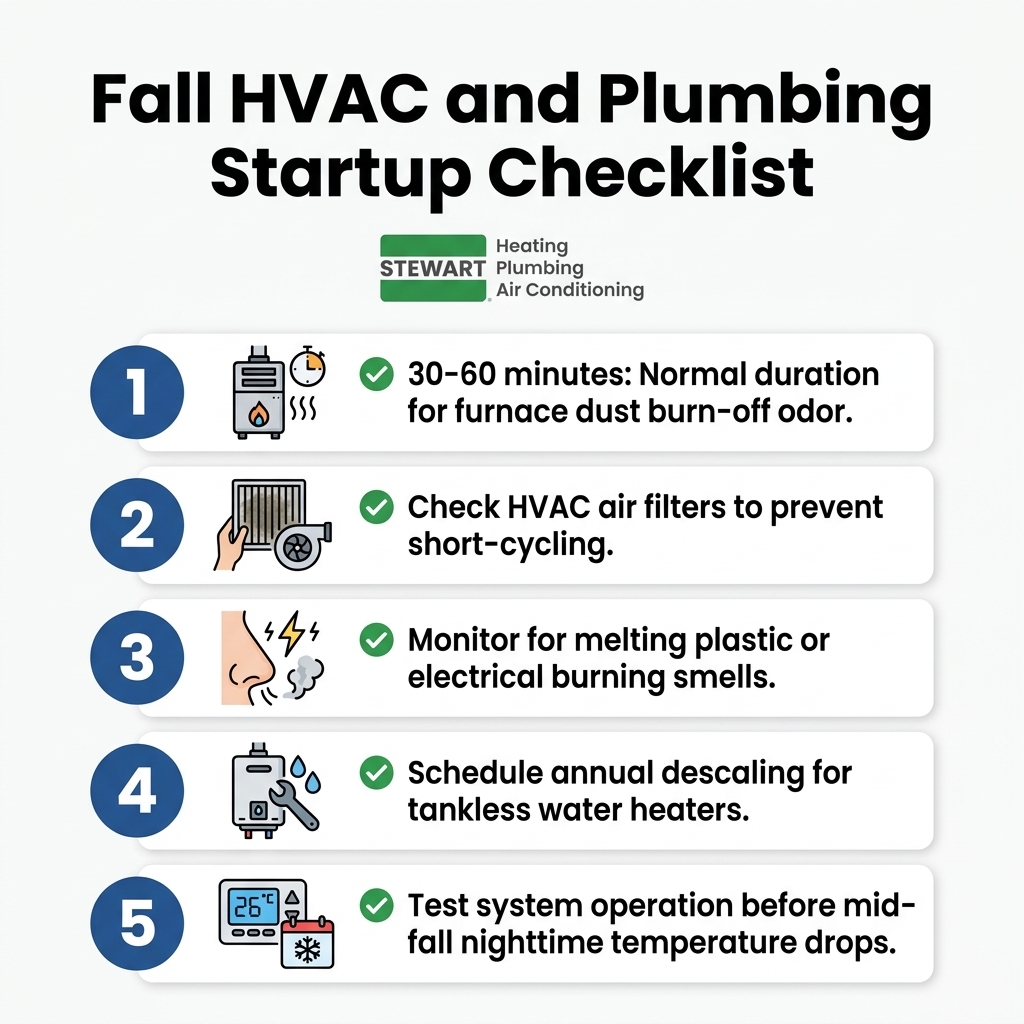
• The duration: This harmless burn-off process typically lasts between 30 to 60 minutes.
• The safe approach: Open a few windows to ventilate the house, let the system run continuously, and monitor the odor. If the smell begins to dissipate within the first hour, your system is experiencing a standard seasonal transition.
While burning dust is normal, other odors indicate a serious mechanical or electrical failure that requires immediate professional intervention. Knowing the difference can protect your home from significant damage.
• Musty or damp smell — Likely Cause: Mildew buildup in ductwork or a dirty filter — Required Action: Replace the air filter; consider a duct inspection if it persists.
• Melting plastic or rubber — Likely Cause: Failing electrical components, overheated wires, or a foreign object in the duct — Required Action: Turn off the furnace immediately at the thermostat and breaker. Call a professional.
• Acrid electrical burning — Likely Cause: A seared blower motor or failing capacitor — Required Action: Shut down the system immediately to prevent electrical fire risks.
• Rotten egg odor (sulfur) — Likely Cause: A natural gas leak — Required Action: Evacuate the home, leave doors open, and call your gas provider and a licensed HVAC technician.
If your furnace smells like burning when turned on for first time and the odor resembles electrical wiring or persists well beyond the 60-minute mark, do not attempt to dismantle the cabinet to find the source. Shut the system down and wait for an expert evaluation.
Another common issue our HVAC team encounters during a mid-fall October heating startup is short-cycling. This occurs when your furnace turns on, blows warm air for a brief period (often just a few minutes), and then abruptly shuts down before the thermostat reaches its set temperature. It then repeatedly turns back on, stuck in an endless, inefficient loop.
The mechanics of short-cycling:
1. The ignition sequence begins: The thermostat calls for heat, the burners ignite, and the blower motor starts pushing air.
2. Airflow is restricted: Due to a clogged air filter, blocked return vents, or closed supply registers, the system cannot push enough air over the heat exchanger to keep it cool.
3. Internal temperatures spike: Without adequate airflow, the heat exchanger rapidly overheats.
4. The safety shutdown: A critical component detects the dangerous temperature and cuts power to the burners to prevent a fire or a cracked heat exchanger.
The component responsible for that safety shutdown is the high limit switch. This small but vital sensor monitors the internal temperature of the furnace cabinet. When the furnace overheats due to restricted airflow, the high limit switch trips, shutting off the gas valve while leaving the blower running to cool the system down.
Ignoring a furnace that repeatedly trips its high limit switch is incredibly damaging. Constant overheating stresses the metal of the heat exchanger, leading to cracks. A cracked heat exchanger can allow carbon monoxide to leak into your living space, turning a minor airflow issue into a severe health hazard. As a homeowner, your role is to verify that all air filters are clean and all room vents are fully open. If the system continues to short-cycle after replacing a dirty filter, the diagnostic work must be handed over to a licensed professional.
When building out a seasonal home maintenance checklist, many homeowners focus entirely on their heating and cooling systems, forgetting that their plumbing is equally impacted by the changing weather. Our plumbers consistently see the impact of this during the cooler winter months in Contra Costa County, when the incoming groundwater temperature drops significantly. This environmental shift places a massive, often unexpected burden on your water heating equipment.
In the summer, your water heater might only need to raise the temperature of incoming 70-degree water by a few dozen degrees to reach a comfortable 120 degrees at the tap. However, during a mid-fall October heating startup and into the winter, that incoming groundwater can drop into the 50s. Suddenly, the system has to work twice as hard to bridge the temperature gap (known as the temperature rise or Delta-T).
This increased workload frequently exposes underlying maintenance issues that were completely unnoticeable during the warmer months. A system that kept up perfectly in July might suddenly fail to deliver enough hot water for a morning shower in November. Proactive plumbing checks are essential to catch these vulnerabilities before the true winter extremes hit. If you notice a drop in water pressure or temperature consistency, it is time to request plumbing service to ensure your system can handle the seasonal load.
Tankless water heaters are highly efficient marvels of modern plumbing, providing hot water on demand without the standby energy losses of a traditional tank. However, their complex internal components require precise, regular maintenance to function correctly, especially when facing the increased demand of colder incoming water during a mid-fall October heating startup.
As a family-owned local business that has been solving East Bay plumbing issues since 1974, we have seen firsthand how skipped maintenance can lead to premature tankless system failures. These units rely on a delicate balance of flow sensors, precise gas valves, and clear venting to operate safely.
A cooler-months tankless maintenance checklist includes:
• Checking the air intake and exhaust vents: Ensuring no leaves, debris, or pests have blocked the venting pipes during the summer. Blocked venting will cause the system to shut down for safety.
• Cleaning the inline water filter: Tankless units have a small screen filter on the cold water inlet. If this becomes clogged with municipal sediment, the flow sensor will not register enough water movement to ignite the burners.
• Inspecting the ignition system: Ensuring the spark igniter and flame rod are clean and functioning, allowing the system to fire up immediately when a hot water tap is opened.
• Evaluating the heat exchanger: Checking for signs of scale buildup or exterior corrosion that could impede heat transfer.
Because these systems are highly technical, taking advantage of seasonal plumbing specials for a professional tune-up is a smart investment in the longevity of your equipment.
The single most critical maintenance task for a tankless water heater is the annual descaling flush. When hard water is heated rapidly inside the narrow channels of a tankless heat exchanger, calcium and magnesium minerals precipitate out of the water and cling to the metal walls. This scale buildup acts as a powerful insulator.
As the scale thickens, the heat exchanger can no longer transfer heat efficiently to the water. The system has to burn more gas and run hotter to achieve the same water temperature, which stresses the metal and drastically shortens the lifespan of the unit. Descaling requires specialized pumping equipment and a specific descaling solution to dissolve the minerals safely without damaging the internal components. This is not a task to skip, especially in areas prone to hard water.
At Stewart Heating, Plumbing and Air Conditioning, we believe a successful seasonal home maintenance checklist empowers you to monitor your home safely while clearly defining the boundaries of do-it-yourself maintenance. Knowing when to step back and call a professional prevents minor issues from escalating into dangerous situations or costly repairs.
When to observe and handle it yourself:
• If your furnace smells like burning when turned on for first time, but the odor is clearly just dusty and begins fading within 30 minutes.
• Replacing your HVAC air filters every 1-3 months.
• Checking that all supply and return vents in your home are unblocked by furniture or rugs.
• Clearing leaves and debris away from the exterior venting pipes of your furnace and tankless water heater.
When to call a licensed professional immediately:
• If your furnace is short-cycling even after you have installed a brand-new, clean air filter.
• If you detect the smell of melting plastic, burning electrical wires, or raw natural gas.
• If your tankless water heater displays an error code on its digital screen and refuses to produce hot water.
• If the high limit switch on your furnace repeatedly trips, indicating a severe internal overheating issue.
Complex diagnostic work involving natural gas lines, 120V or 240V electrical connections, and carbon monoxide venting must always be handled by a certified technician. If you are dealing with an ignition failure, reviewing a guide on troubleshooting a tankless water heater that won't ignite can help you understand the mechanics, but the physical repair should remain in the hands of an expert.
The burning dust smell is caused by the incineration of airborne particles that settled on your furnace's heat exchanger during the summer. When the system sits dormant for months, dust, pet dander, and lint accumulate on the internal metal components. Once the thermostat calls for heat and the burners ignite, the heat exchanger reaches high temperatures rapidly, burning off this settled debris. This is a normal part of the seasonal transition and does not indicate a malfunction, provided the smell is purely dusty and not electrical.
A normal dust burn-off odor should last between 30 to 60 minutes during the first continuous heating cycle of the season. If your furnace smells like burning when turned on for first time, the best practice is to open a few windows to ventilate the space and let the system run. If the smell persists beyond an hour, grows stronger, or changes to a melting plastic or electrical odor, shut the system down immediately at the thermostat and contact a professional for an inspection.
A comprehensive fall home maintenance checklist must address both your heating and plumbing systems before winter weather arrives. Essential tasks include replacing HVAC air filters to prevent airflow restrictions, testing smoke and carbon monoxide detectors, and observing the first heating cycle for abnormal noises or persistent odors. On the plumbing side, the checklist should include scheduling an annual descaling flush for tankless water heaters and insulating exposed exterior pipes to protect against sudden temperature drops.
Short-cycling in the fall is most frequently caused by restricted airflow, which forces the furnace's high limit safety switch to trip and shut down the burners to prevent overheating. Over the summer, air filters often become clogged with dust and allergens; if they aren't replaced before the heating season, the system cannot push enough air over the heat exchanger to keep it cool. Other causes include blocked return vents, a malfunctioning thermostat, or a failing flame sensor that cannot detect whether the burners are properly lit.
Your tankless water heater struggles in the cooler months because the incoming groundwater temperature drops significantly, requiring the system to work much harder to reach your desired output temperature. In the summer, the unit might only need to heat the water by 40 degrees, but in the winter, that gap (the temperature rise) can increase to 70 degrees or more. If the system is suffering from mineral scale buildup or restricted gas flow, it will fail to bridge this larger temperature gap, resulting in lukewarm water or fluctuating temperatures.
A tankless water heater should be professionally flushed and descaled at least once a year to maintain efficiency and prevent internal damage. In areas with particularly hard water, where calcium and magnesium levels are high, a flush every six to nine months may be necessary to keep the heat exchanger clear. Skipping this maintenance allows mineral scale to act as an insulator inside the unit, forcing the system to burn more fuel, overheat, and eventually fail prematurely.
Navigating a mid-fall October heating startup doesn't have to be a stressful experience. By understanding the normal behaviors of your mechanical systems—like the temporary odor of burning dust—and recognizing the clear warning signs of short-cycling or plumbing strain, you can take control of your home's comfort. A robust seasonal home maintenance checklist bridges the gap between proactive homeowner observation and essential professional intervention.
Our team at Stewart Heating, Plumbing and Air Conditioning has seen too many winter emergencies that could have been easily prevented. Don't wait until the first freezing night to discover that your furnace's heat exchanger is compromised or your tankless water heater is choked with mineral scale. Definitive, expert safety evaluations provide the peace of mind that your home is prepared for whatever the winter weather brings. Schedule your comprehensive pre-winter inspection with our experienced local professionals today, and be sure to ask us if any generally applicable energy rebates or tax credits apply to your high-efficiency upgrades.

Very professional and complete. I would recommend Stewart to anyone. Highest quality of workmanship and clean installation.
Stewart Heating Plumbing Air Conditioning just did some work for us for the first time. They did an installation at my home and it turned out well. I thought the price was fair and I definitely would use them again. The technicians were very friendly and knowledgeable about their work. I highly recommend Stewart Heating Plumbing Air Conditioning and already told friends to use them.
We have been using Stewart Heating Plumbing Air Conditioning since 1995. They put the original heating and air unit in the house, and we have just stayed with them. They are dependable and honest people, and they have done a good job for us every time that we have used them!
They came and did an inspection and are coming tomorrow to do the repair.
They replaced a regulator the first time, and then the water heater vent had to be replaced. They did great work.
The gentleman that serviced us was helpful, insightful, and knew what he was talking about. Overall, it was a great experience.