

Recent Blogs
Stay updated with our latest blog posts.
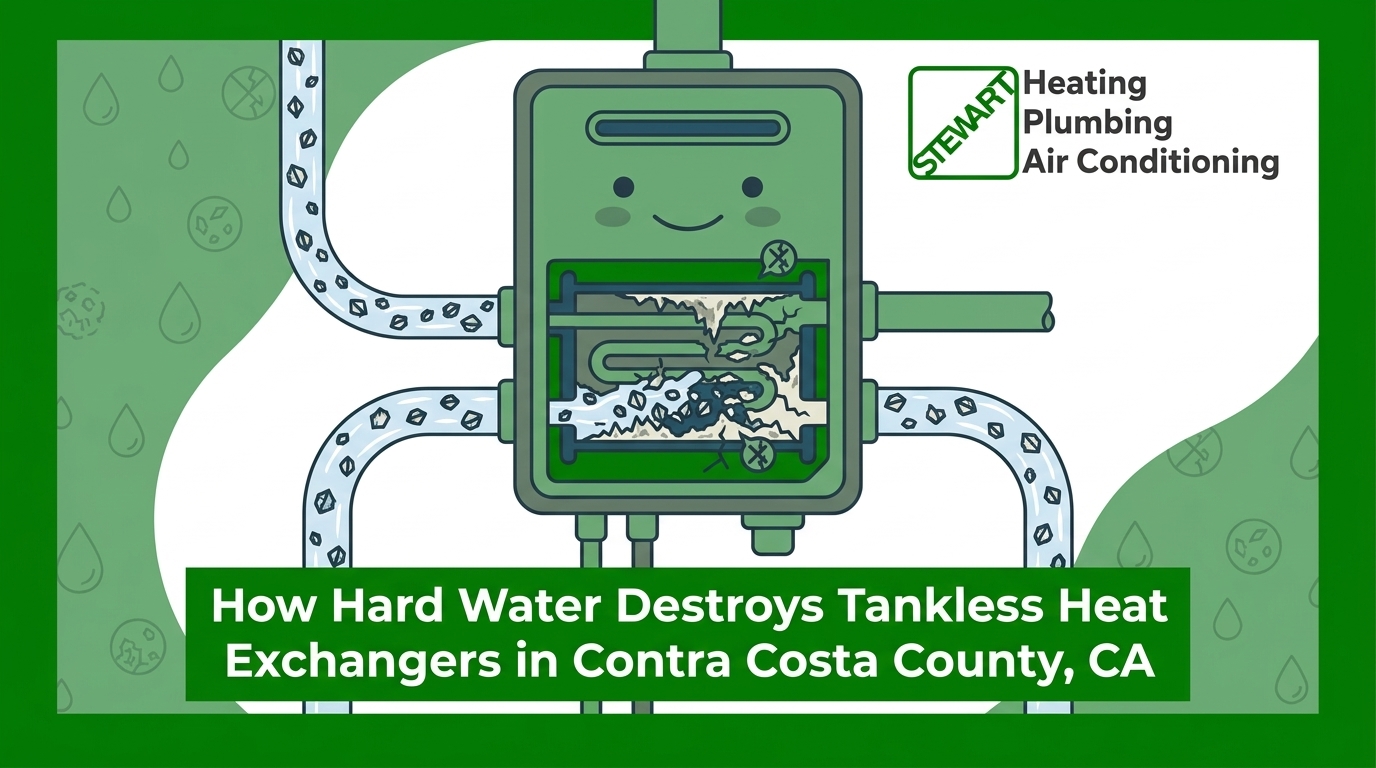
Your system was supposed to provide endless showers, but understanding how hard water in Contra Costa County destroys tankless heat exchangers is the only way to keep that promise alive. At Stewart Heating, Plumbing and Air Conditioning, we've seen countless tankless water heaters—which are true engineering marvels designed for high efficiency—brought to their knees by aggressive mineral buildup. The local municipal water supply contains dissolved minerals that quietly attack unprotected systems from the inside out. As we transition into September and early fall, household hot water usage naturally spikes. This shift in seasonal demand makes proactive scale prevention not just a recommendation, but an absolute necessity to prevent premature system failure.
For comprehensive solutions to protect your home's pipes and fixtures, explore our expert plumbing services.
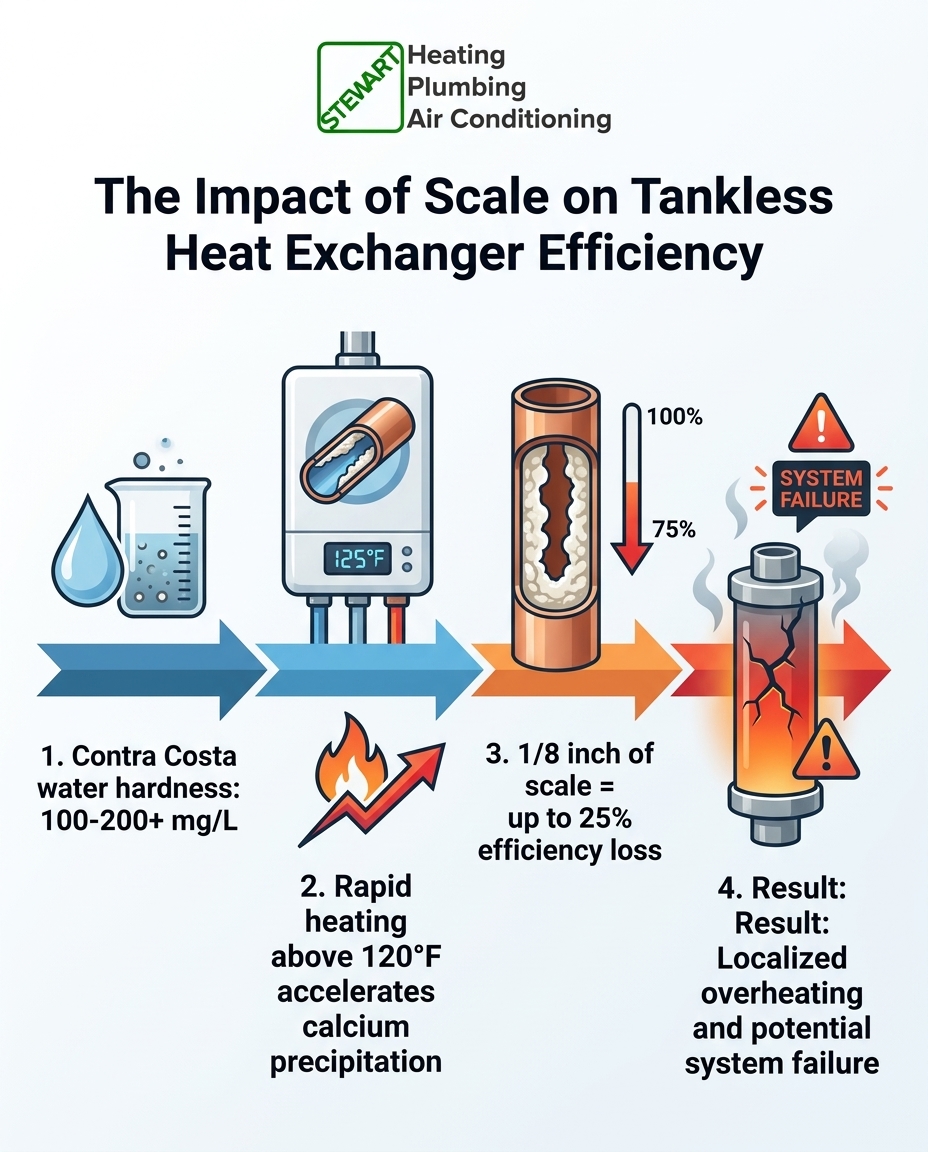
To understand why tankless systems fail prematurely in our region, we always tell our customers to look at the chemistry of the local water supply. Contra Costa County draws a significant portion of its municipal water from the Delta, and this water carries specific dissolved calcium and magnesium levels. Depending on the exact source and the time of year, local water hardness typically ranges from 100 to well over 200 milligrams per liter (mg/L). While this mineral-rich water is perfectly safe for drinking, our technicians know firsthand that it creates a hostile environment for high-efficiency plumbing appliances.
The core problem is a chemical reaction that occurs during the rapid heating process. When water is heated above 120 degrees Fahrenheit, the dissolved calcium and magnesium can no longer stay suspended in the liquid. They precipitate out, transforming from dissolved ions into solid rock-like scale. Because tankless water heaters rely on rapid, intense heat to instantly warm the water passing through them, they trigger this precipitation process much faster than older appliances.
The Rapid Heating Difference
Traditional storage tank water heaters heat a large volume of water slowly. While they still accumulate sediment at the bottom of the tank, the process is gradual. Tankless systems, on the other hand, flash-heat water as it travels through incredibly narrow passages. The scale doesn't settle at the bottom of a tank; it bakes directly onto the heat exchanger walls.
• Traditional Tank — Heating Method: Slow, ambient heating of a large volume — Where Scale Accumulates: Settles loosely at the bottom of the tank — Impact of Hard Water: Gradual efficiency loss, rumbling noises
• Tankless System — Heating Method: Flash-heating via intense, direct burners — Where Scale Accumulates: Bakes directly onto narrow heat exchanger walls — Impact of Hard Water: Rapid flow restriction, overheating, system lockouts
Because of this accelerated scaling process, generic maintenance timelines provided by out-of-state manufacturers are often insufficient for the realities of the water table in Contra Costa County and Pittsburgh CA. In our daily service calls, we find that a maintenance schedule designed for the soft water of the Pacific Northwest will leave an East Bay tankless unit severely compromised within just a couple of years.
The heat exchanger is the most critical and expensive component of your tankless water heater. To maximize heat transfer, manufacturers design these components with a series of very narrow, tightly coiled metal passages. Water flows through these tight channels while a powerful gas burner or electric element applies intense heat to the exterior of the metal. This design is highly efficient, but it leaves zero margin for error when it comes to mineral buildup.
When calcium precipitates out of the water, it clings to the inside walls of the heat exchanger. Calcium is a natural insulator. Just a 1/8-inch layer of scale buildup can reduce the heating efficiency of the unit by up to 25 percent. The system's internal sensors detect that the water isn't reaching the target temperature, so the computer commands the burners to fire hotter and longer. The unit is now burning more fuel to push heat through a layer of solid rock just to warm your water.
The consequence of this overworking is severe:
• Localized overheating: The metal of the heat exchanger becomes dangerously hot because the water isn't absorbing the heat fast enough.
• Thermal stress: The constant overheating and cooling cycle causes the metal to expand and contract unnaturally.
• Structural failure: Eventually, the stressed metal cracks, leading to internal water leaks and catastrophic system failure.
Our Stewart Heating, Plumbing and Air Conditioning field technicians have spent decades diagnosing localized hard water damage in the East Bay. Since 1974, we have seen firsthand what unprotected units look like when opened for inspection. A heat exchanger that should look like clean copper or stainless steel is often found choked with thick, white, chalky deposits. Recognizing these patterns of failure is something that comes with our deep local experience, allowing our team to identify issues that newer technicians might easily miss.
If you suspect your system is already suffering from this kind of buildup, learning about the process of a descaling flush for your tankless water heater is a critical next step.
When scale begins to choke a heat exchanger, the system doesn't usually fail all at once. It sends warning signs. Many homeowners call our dispatch center searching for solutions to tankless water heater problems without realizing that the root cause is the mineral content of their water. By the time you notice these symptoms, we typically find the heat exchanger is already struggling and requires professional diagnosis.
Here are the primary symptoms that indicate your system is suffering from severe calcification:
1. The "No Hot Water" Scenario: Experiencing a no hot water tankless water heater situation is the most common complaint. Modern tankless units are equipped with sensitive flow and temperature sensors. If scale restricts the water flow too much, or if the heat exchanger overheats due to calcium insulation, the system's safety switches will trip. The unit will shut down entirely and flash an error code on the digital display to prevent a fire hazard or internal meltdown.
2. Sudden Drops in Water Pressure: Tankless systems require a minimum flow rate to activate the burners. As scale thickens inside the narrow passages of the heat exchanger, it physically chokes the flow of water. You might notice that the hot water pressure at your showerhead is noticeably weaker than the cold water pressure.
3. Unusual Rumbling or Popping Noises: While more common in traditional tanks, heavily scaled tankless units can also produce strange sounds. As the burners struggle to push heat through the calcium layer, small pockets of water trapped under the scale can boil and pop, creating a rumbling noise during operation.
4. Fluctuating Water Temperatures: If your shower goes from hot to cold and back to hot again (often called the "cold water sandwich"), scale may be coating the temperature sensors. The system receives delayed or inaccurate temperature readings, causing the burners to cycle on and off erratically.
If you are experiencing any of these symptoms in Contra Costa County or Pittsburgh CA, the unit needs immediate attention before the heat exchanger cracks. For prompt evaluation, you can rely on our professional water heater repair in Pittsburg to accurately diagnose the error codes and assess the internal damage.
The mechanical issue of scale buildup becomes significantly more urgent as the seasons change. The transition into September and early fall marks a critical shift in how your plumbing system operates. During the hot summer months, the municipal groundwater traveling through the underground pipes is relatively warm. The tankless unit doesn't have to work very hard to raise that water to your desired shower temperature.
However, as we move deeper into fall and winter, there is a specific seasonal drop in East Bay groundwater temperatures. The water entering your home becomes much colder. This means your tankless water heater must achieve a much larger "temperature rise" to deliver the same 120-degree hot water to your tap. To accomplish this, the burners must fire longer and at higher intensities.
The Danger of Increased Workload
This increased workload is exactly what accelerates scale precipitation. Just as household hot water demand is increasing—with longer, hotter showers and more frequent loads of laundry—the system is being pushed to its mechanical limits. If the heat exchanger is already partially coated in scale from the summer, the heavy demands of fall can be the breaking point that causes the metal to crack or the safety sensors to lock the unit out entirely.
Addressing overdue service before this heavy usage period is vital. One local homeowner recently reached out to us because their water heater service was severely overdue, especially after tradesmen from another company had failed to show up the week prior. We were able to get their maintenance scheduled and completed promptly. By performing a thorough system review and flush before the cold weather set in, they avoided a sudden breakdown during the busiest time of the year. In our experience, proactive maintenance is the only reliable way to ensure your system survives the winter workload.
Understanding the threat of hard water is only half the battle; implementing the right solution is what actually protects your home. Many homeowners assume that if their heat exchanger fails, the manufacturer's warranty will cover the replacement. This is a costly misconception. The vast majority of tankless water heater manufacturers explicitly state in their manuals that damage caused by scale buildup is not a manufacturing defect, and therefore, it voids the warranty. You are entirely responsible for managing the water quality entering the unit.
To protect your investment, tankless units in hard water areas must be paired with appropriate water treatment. There are two primary ways to handle this:
• Scale Inhibitors: These are specialized inline filters installed directly on the cold water supply line feeding the tankless unit. They do not remove the calcium from the water; instead, they introduce a polyphosphate solution that binds to the mineral ions. This prevents the calcium from precipitating out and clinging to the heat exchanger walls during rapid heating. They are highly effective, require zero electricity, and only need their filter cartridges swapped out periodically.
• Whole-Home Water Softeners: A true water softener uses an ion-exchange process to physically remove calcium and magnesium from the water, replacing them with sodium ions. This protects not only the tankless water heater but every plumbing fixture, dishwasher, and washing machine in the house.
Regardless of which prevention method you choose, routine professional maintenance remains non-negotiable. Our Stewart Heating, Plumbing and Air Conditioning field technicians strongly advise an annual descaling flush for homes in our service area. This process involves isolating the unit from the home's plumbing and circulating a specialized, professional-grade descaling solution through the heat exchanger for nearly an hour to dissolve existing buildup. Because this involves manipulating gas valves, pressure relief systems, and highly acidic solutions, we always stress that it requires a licensed professional to perform safely.
If your system has locked out and you need immediate assistance, seek out emergency tankless water heater repair to safely restore your hot water.
Yes, hard water will eventually ruin an unprotected tankless water heater. The dissolved calcium and magnesium precipitate out during the rapid heating process, baking onto the narrow walls of the heat exchanger. Over time, this solid scale acts as an insulator, forcing the system to overheat to warm the water, which eventually causes the heat exchanger to crack and leak.
A lack of hot water usually means the system's internal safety sensors have triggered a shutdown. When scale restricts water flow or causes the heat exchanger to overheat, the computer locks out the burners to prevent a fire hazard or internal damage. You will typically see an error code flashing on the digital controller indicating a flow restriction or exhaust issue.
In areas with hard municipal water, you should have a professional flush your tankless water heater at least once a year. If your home has exceptionally hard water and you do not have a scale inhibitor or water softener installed, you may need to schedule a descaling flush every six to nine months to prevent permanent damage to the heat exchanger.
While you don't strictly need a whole-home water softener, you absolutely need some form of scale prevention. If you do not want to install a water softener, you must install an inline scale inhibitor filter directly on the water supply line feeding the tankless unit. Without one of these two protections, the manufacturer's warranty on the heat exchanger is typically voided.
Hard water causes problems by leaving behind mineral deposits that choke the internal plumbing of the unit. This scale buildup restricts water pressure, coats temperature sensors causing erratic hot and cold fluctuations, and forces the burners to overwork. The resulting thermal stress leads to frequent error codes, system lockouts, and eventual component failure.
Understanding local water chemistry is the first and most important step in protecting your high-efficiency plumbing investments. The mineral content in our local water supply is relentless, and hoping that a tankless unit will survive without proper filtration or maintenance is a gamble that usually ends in a costly heat exchanger replacement.
Before the colder groundwater of fall and winter pushes your system to its limits, we highly recommend having our local experts evaluate your unit for early signs of calcification. Taking action now ensures that your family won't be left taking cold showers on a chilly morning. Explore professional tankless water heater installation and service options today to guarantee reliable, efficient hot water all season long.

Very professional and complete. I would recommend Stewart to anyone. Highest quality of workmanship and clean installation.
Stewart Heating Plumbing Air Conditioning just did some work for us for the first time. They did an installation at my home and it turned out well. I thought the price was fair and I definitely would use them again. The technicians were very friendly and knowledgeable about their work. I highly recommend Stewart Heating Plumbing Air Conditioning and already told friends to use them.
We have been using Stewart Heating Plumbing Air Conditioning since 1995. They put the original heating and air unit in the house, and we have just stayed with them. They are dependable and honest people, and they have done a good job for us every time that we have used them!
They came and did an inspection and are coming tomorrow to do the repair.
They replaced a regulator the first time, and then the water heater vent had to be replaced. They did great work.
The gentleman that serviced us was helpful, insightful, and knew what he was talking about. Overall, it was a great experience.