

Recent Blogs
Stay updated with our latest blog posts.

You turn the thermostat to "heat" for the first time in months, and within minutes, an unsettling burning smell fills the hallway. For many homeowners, the mid-fall October furnace startup brings an immediate wave of anxiety. You find yourself standing near the vent, wondering if that odor is just a harmless seasonal quirk or a sign of a serious fire hazard. Building a proactive, comprehensive seasonal home maintenance checklist is the best way to eliminate that guesswork and protect your property before the cold weather sets in.
This guide is designed to walk you through the essential safety checks for your heating and plumbing systems. By understanding exactly what happens when your equipment wakes up from its summer hibernation, you can confidently distinguish between normal operation and true emergencies. If you find that your home requires professional attention, you can always explore tankless water heater services or request plumbing service to ensure everything runs smoothly all winter long.
The short answer is that your heating system acts as a dust trap during the warmer months. When you live in the East Bay, the local Mediterranean climate means your furnace likely sits completely idle for six to eight months out of the year. During that long, dry downtime, household dust, pet dander, and airborne particles settle directly onto the furnace's internal components, particularly the heat exchanger.
When you initiate that mid-fall October furnace startup, the burners ignite, and the heat exchanger rapidly warms up to hundreds of degrees. The layer of dust that has been resting on the metal surface is instantly incinerated. Because your blower motor is simultaneously pushing air over that heat exchanger and into your ductwork, the smell of burning dust is immediately distributed throughout every room in your home. Here at Stewart Heating, Plumbing and Air Conditioning, our dispatch team fields dozens of calls every October from concerned Pittsburgh homeowners about this exact odor.
The quick fix: Patience and ventilation. This specific, dusty odor is an entirely normal part of the seasonal transition. It does not mean your furnace is broken, and it does not necessarily mean your home is in danger. In a properly functioning system, this smell typically dissipates within 15 to 30 minutes of the first heating cycle. Opening a few windows during this initial run can help clear the air faster.
While a burning dust smell is harmless, other odors and noises are urgent warning signs. According to the National Fire Protection Association (NFPA), heating equipment remains a leading cause of fires in U.S. homes. Taking unusual symptoms seriously during your mid-fall October furnace startup is critical for your family's safety.
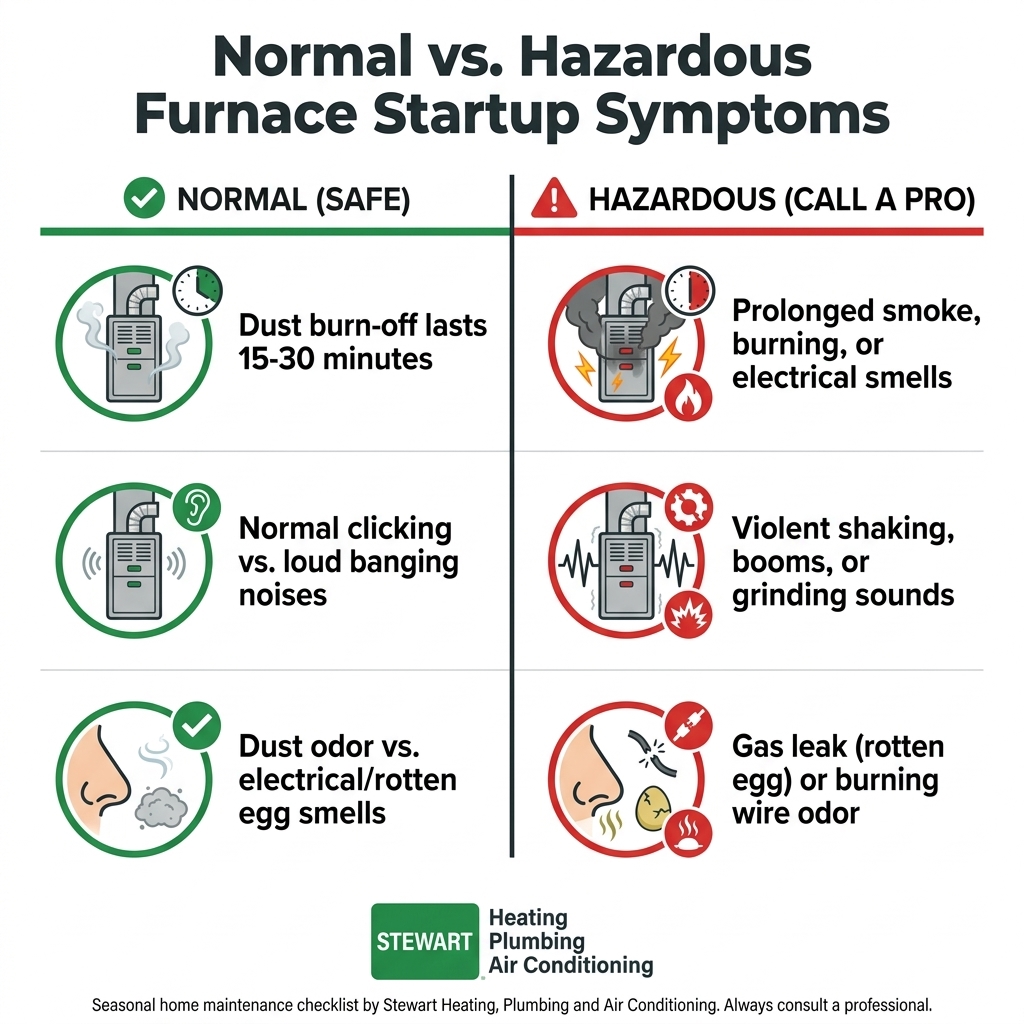
In our experience servicing East Bay homes since 1974, we've found it is vital to know the difference between a system that is simply shaking off the cobwebs and a system that is actively failing. If you experience any of the hazardous symptoms listed below, shut your heating system down immediately at the thermostat and contact a licensed professional.
• Odors — Normal Startup Behavior: Musty or burning dust smell lasting 15-30 minutes. — Hazardous Warning Sign: Rotten eggs (sulfur), melting plastic, or electrical burning smells. — Required Action: Shut down immediately. Evacuate if you smell gas. Call for emergency service.
• Sounds — Normal Startup Behavior: Gentle clicking during ignition, soft metal expansion "pings." — Hazardous Warning Sign: Loud booming, violent banging, grinding, or high-pitched squealing. — Required Action: Turn off the system. A loud boom indicates delayed gas ignition, which damages the unit.
• Airflow — Normal Startup Behavior: Slightly cool air for the first minute, transitioning to warm air. — Hazardous Warning Sign: Weak airflow, cold air blowing continuously, or rapid cycling on and off. — Required Action: Check your air filter first. If clean, request a professional diagnostic.
To ensure a smooth transition into the heating season for your Pittsburgh, CA home, proactive preparation is key. Following a structured checklist before you turn on the heat can prevent unexpected breakdowns and improve your home's energy efficiency. Here are the foundational steps every homeowner should take:
1. Check and replace the HVAC air filter: A clogged filter restricts airflow, forcing your furnace to work harder and increasing the risk of overheating. Start the season with a fresh, high-quality pleated filter.
2. Clear all supply and return vents: Walk through every room in your house and ensure that rugs, heavy furniture, and curtains are not blocking your registers. Blocked vents increase static pressure inside your ductwork, which strains the blower motor.
3. Test the thermostat communication: Turn the thermostat to "heat" and raise the temperature a few degrees above the current room temperature. Listen for the furnace to engage. If nothing happens, check the thermostat batteries before assuming the furnace is broken.
4. Inspect the area around the indoor unit: Ensure there is a clear perimeter of at least two feet around your furnace. Remove any stored items, especially flammable materials like cardboard boxes or cleaning supplies.
5. Schedule a comprehensive inspection: The most effective way to catch hidden wear and tear before it becomes a safety risk is to enroll in a routine maintenance plan. A professional technician will clean the burners, test safety controls, and inspect the heat exchanger for microscopic cracks.
While the furnace gets most of the attention during a mid-fall October furnace startup, your plumbing system also faces new seasonal stressors. In the East Bay, cooler autumn weather causes a noticeable drop in the temperature of the municipal groundwater entering your home. This change puts extra strain on your water heating systems.
Tankless water heaters operate by measuring the temperature of the incoming water and calculating how much energy is needed to heat it to your desired output. When the incoming groundwater is significantly colder in the fall and winter, the unit has to work much harder to achieve that "temperature rise." A pattern our plumbers see often during this season is units being forced beyond their capacity, causing them to restrict water flow to ensure the water gets hot enough, resulting in lower water pressure at your faucets.
Additionally, dropping temperatures often highlight neglected maintenance. Mineral scaling from hard water can clog the inlet filters on a tankless unit. If you find yourself dealing with cold showers, troubleshooting a tankless water heater that won't ignite often begins with checking for these flow restrictions. A complete seasonal checklist must prioritize both air and water systems to keep your household comfortable.
The transition from dry, dusty summers to cooler fall evenings brings unique indoor air quality challenges for homeowners in Pittsburgh, CA. Months of stagnant air, open windows, and regional environmental factors lead to significant particulate buildup inside your ductwork and living spaces.
When the blower motor kicks on for the first time in months, it doesn't just circulate heat; it acts as a fan blowing all that settled summer dust back into your breathing air. This sudden circulation can trigger allergies and respiratory irritation just as cold and flu season begins.
The fan-only trick: In our years of helping local families breathe easier, we highly recommend running your HVAC system on "fan only" mode (without engaging the heat) for a few hours a day in the weeks leading up to your first heating cycle. This allows your system to cycle the indoor air through the filter, capturing loose debris before the heat exchanger gets involved. Furthermore, upgrading to a higher MERV-rated filter (such as a MERV 11 or 13, if your system can accommodate the airflow) during the fall will help capture a larger percentage of airborne particles, pollen, and pet dander.
Taking pride in maintaining your home is commendable, but knowing where to draw the line is essential for your safety. Modern home comfort systems are complex, highly regulated pieces of machinery. A standard seasonal home maintenance checklist should empower you to handle basic upkeep, but it should also clarify when expert intervention is non-negotiable.
Any work that involves natural gas lines, internal electrical components, or the combustion chamber of a furnace strictly requires a licensed professional. Attempting to clean burners, adjust gas pressure, or repair a cracked heat exchanger on your own can lead to catastrophic outcomes, including carbon monoxide leaks or electrical fires.
Peace of mind is paramount when dealing with the equipment that keeps your family warm and safe. If your troubleshooting reveals a complex issue, or if your system exhibits any of the hazardous symptoms discussed earlier, do not hesitate to call for backup. As a family-owned business serving Contra Costa County since 1974, we understand the specific needs of Pittsburgh, CA homes. Relying on established local experts ensures that your safety-critical inspections are handled with the utmost care and precision.
Yes, a burning dust smell is entirely normal as settled debris burns off the heat exchanger. During the long months of summer inactivity, dust naturally accumulates on the internal components of your heating system. When the burners ignite for the first time during your mid-fall October furnace startup, this dust incinerates, creating a distinct, temporary odor that circulates through your vents.
The odor typically lasts between 15 and 30 minutes during the first cycle. If it persists longer than an hour, or if the smell changes from burning dust to something resembling melting plastic or rotten eggs, turn off the unit immediately. Persistent or chemical odors indicate a mechanical or electrical failure that requires professional diagnosis.
Standard maintenance includes filter replacement, thermostat calibration, burner inspection, and safety control testing. A professional technician will also clean the flame sensor, inspect the heat exchanger for dangerous cracks, and ensure the blower motor is operating efficiently. Completing these steps prevents mid-winter breakdowns and ensures the system operates safely.
Most East Bay residents perform their initial startup in October when nighttime temperatures begin dropping into the 50s. However, our technicians always advise testing your heating system on a mild day in late September to ensure it functions properly. Testing early gives you ample time to schedule repairs without competing with the first major cold snap of the season.
Yes, mineral scaling and clogged inlet filters can restrict flow, causing tankless units to shut down as a safety precaution. Tankless systems require a specific minimum flow rate to ignite the burners. If a dirty filter prevents adequate water from entering the unit, the system will not heat the water, leaving you with a cold shower.
Understanding the difference between normal dust burn-off and actual mechanical hazards empowers you to make safe, confident decisions during the changing seasons. A mid-fall October furnace startup in Pittsburgh, CA shouldn't be a source of stress. By completing your seasonal home maintenance checklist early—checking filters, clearing vents, and monitoring water heater performance—you set your home up for reliable comfort.
Remember that you don't have to tackle the complex technical work alone. If any step of your checklist reveals a larger issue, or if you simply want the peace of mind that comes with a professional inspection, local experts are ready to help. Schedule your routine checks today to ensure a safe, warm, and worry-free winter season.

Very professional and complete. I would recommend Stewart to anyone. Highest quality of workmanship and clean installation.
Stewart Heating Plumbing Air Conditioning just did some work for us for the first time. They did an installation at my home and it turned out well. I thought the price was fair and I definitely would use them again. The technicians were very friendly and knowledgeable about their work. I highly recommend Stewart Heating Plumbing Air Conditioning and already told friends to use them.
We have been using Stewart Heating Plumbing Air Conditioning since 1995. They put the original heating and air unit in the house, and we have just stayed with them. They are dependable and honest people, and they have done a good job for us every time that we have used them!
They came and did an inspection and are coming tomorrow to do the repair.
They replaced a regulator the first time, and then the water heater vent had to be replaced. They did great work.
The gentleman that serviced us was helpful, insightful, and knew what he was talking about. Overall, it was a great experience.