

Recent Blogs
Stay updated with our latest blog posts.

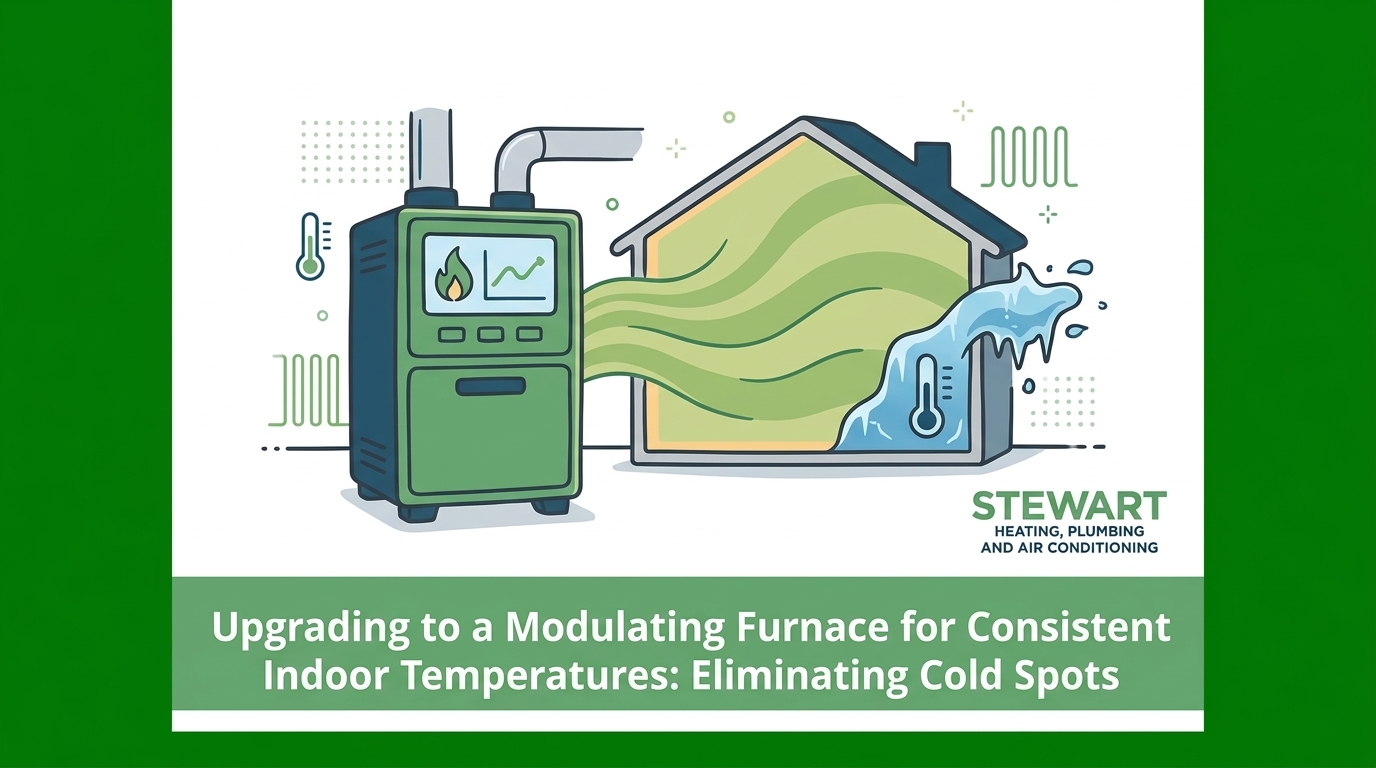
At Stewart Heating, Plumbing and Air Conditioning, one of the most persistent myths we encounter in the home improvement world is that buying a larger heating unit will magically push hot air into every stubborn, freezing corner of your house. In reality, our team frequently finds that oversizing your equipment is the root cause of those uneven temperatures, which is why upgrading to a modulating furnace for consistent indoor temperatures is the actual, scientifically proven solution. Older single-stage furnaces are designed to blast heat at maximum capacity until the thermostat clicks off, creating a frustrating yo-yo effect. You end up sweating while the system runs, only to reach for a blanket ten minutes after it shuts down.
If you are tired of wearing a winter sweater in your own living room, exploring our professional heating services is the first step toward achieving true, balanced comfort.
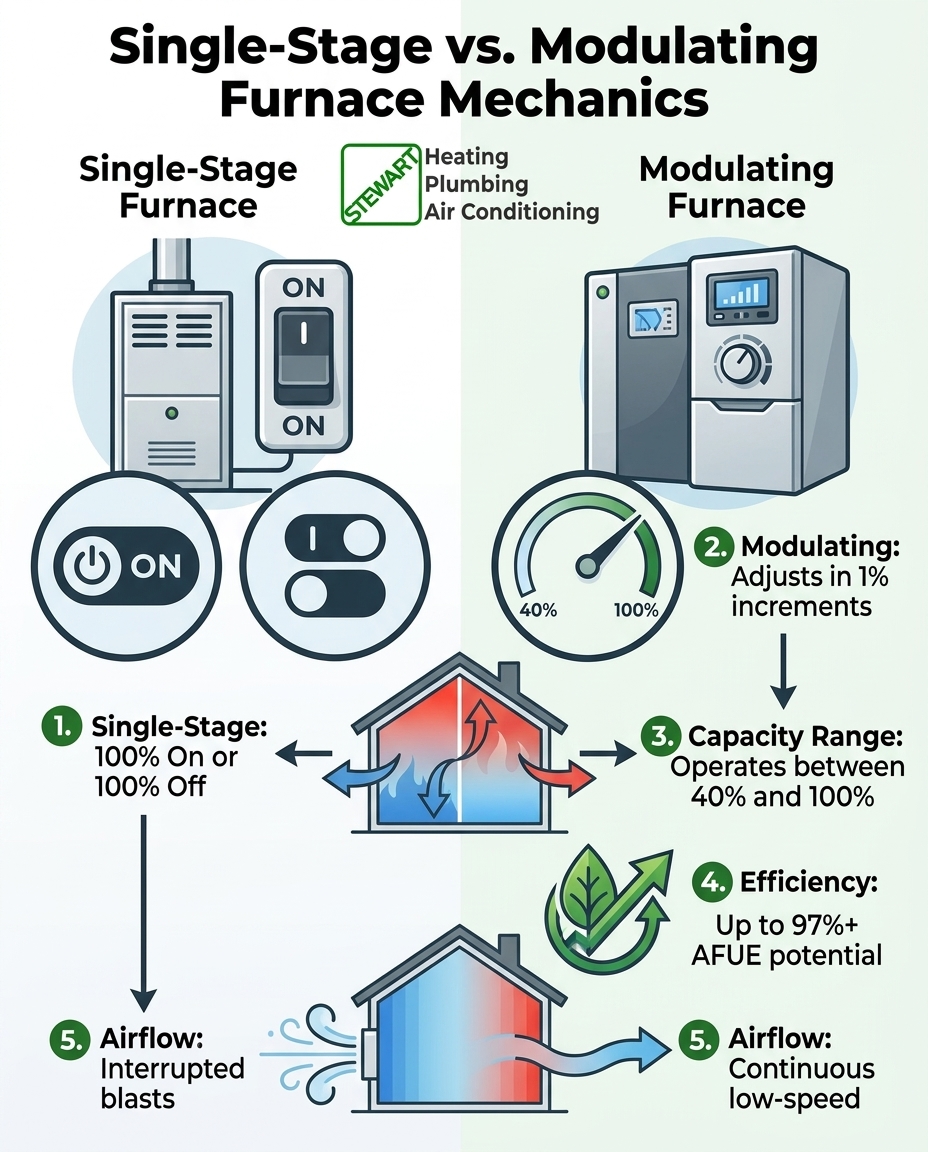
When our technicians compare standard technology against a modern modulating furnace for homeowners, we explain that the difference comes down to control. Traditional systems operate like a simple light switch—they are either completely on or completely off. Modulating systems operate like a dimmer switch, adjusting their output in tiny increments to match your home's exact needs. For larger homes in Pittsburgh CA and the broader East Bay area, we constantly remind our customers that moving away from the "bigger is better" mindset and embracing precision technology is the only way to permanently eliminate cold spots.
To understand why your current heating system leaves certain rooms feeling like iceboxes, we often ask our customers to look at the mechanics of the gas valve. A single-stage furnace only knows two speeds: 100% capacity or 0% capacity. When your thermostat calls for heat, the furnace ignites and pushes a massive volume of hot air into your ductwork. Once the hallway where the thermostat lives reaches the target temperature, the entire system abruptly shuts down, regardless of whether the back bedrooms have warmed up yet.
Modulating technology completely changes this dynamic. Instead of a basic on/off mechanism, these advanced furnaces utilize gas valves that adjust heating output in increments as small as 1%. Typically, a modulating furnace operates anywhere between 40% and 100% of its total capacity. By running at a lower speed for a longer duration, the system continuously filters your indoor air while delivering a steady, gentle stream of warmth.
The short-cycling problem: Traditional single-stage systems are notorious for short-cycling. Because they blast heat at full capacity, they satisfy the thermostat quickly and shut off. In our daily service calls, we see how this constant starting and stopping puts immense mechanical wear and tear on the blower motor and heat exchanger. Furthermore, the energy required to constantly ignite and spin up a heavy blower motor results in significant energy waste. It is much like driving a car in stop-and-go city traffic versus cruising smoothly on the highway.
The micro-adjustment advantage: A modulating gas valve makes continuous micro-adjustments based on real-time feedback from your thermostat. If the temperature outside drops by a few degrees, the furnace slightly increases its gas flow and blower speed to compensate. This allows the system to maintain your indoor temperature within a fraction of a degree of your target setting. For larger homes in Pittsburgh CA and the broader East Bay area, this precision means the temperature in the master bedroom finally matches the temperature in the downstairs living room.
If you live in a multi-story house, you already know the daily struggle of vertical temperature swings. We see this exact scenario constantly during our early fall service calls across the East Bay. Basic physics dictates that heat rises. When a standard single-stage furnace kicks on, it blasts hot air into the home. That heat naturally travels upward, leaving the ground floor freezing while the upper floors quickly overheat. By the time the downstairs thermostat registers that the house is warm enough, the upstairs bedrooms feel like a sauna.
Distance from the blower motor also creates persistent cold spots in sprawling floor plans. Rooms situated at the very end of a long duct run simply do not receive enough sustained airflow from a system that only runs for ten minutes at a time. The hot air stops flowing before it ever reaches the furthest corners of the house.
A modulating furnace solves this structural problem through continuous air circulation. Because the system runs at a lower capacity for longer periods, it constantly mixes the air evenly across all levels of the house. This steady airflow prevents thermal stratification—the layering of hot and cold air—and ensures that every room receives a consistent supply of conditioned air.
In some cases, our team finds these temperature imbalances are worsened by aging zone control systems that struggle to communicate with outdated single-stage equipment. If your motorized dampers are failing while your furnace is blasting full heat, you might be looking at repairing vs replacing a failing zone control board alongside upgrading your primary heating unit. For larger homes in Pittsburgh CA and the broader East Bay area, addressing both the air delivery and the heat generation is the key to whole-house comfort.
When evaluating a major home upgrade, seeing the differences laid out side-by-side helps clarify exactly what you are investing in. Standard furnaces and modulating furnaces represent two completely different generations of heating technology.
• Operation Style — Standard Single-Stage Furnace: 100% On or 100% Off — High-Efficiency Modulating Furnace: Adjusts in 1% increments (40% to 100%)
• Temperature Consistency — Standard Single-Stage Furnace: Fluctuates 2 to 4 degrees from setting — High-Efficiency Modulating Furnace: Maintains within a fraction of a degree
• Noise Level — Standard Single-Stage Furnace: Loud, noticeable start-ups and air blasts — High-Efficiency Modulating Furnace: Whisper-quiet, continuous low-speed operation
• AFUE Efficiency Rating — Standard Single-Stage Furnace: Typically 80% to 90% — High-Efficiency Modulating Furnace: Up to 97%+ AFUE potential
• Air Filtration — Standard Single-Stage Furnace: Intermittent (only filters when running) — High-Efficiency Modulating Furnace: Continuous air mixing and filtration
The long-term efficiency benefits of investing in advanced technology become obvious when you look at the AFUE (Annual Fuel Utilization Efficiency) ratings. A modulating furnace operating at 97% AFUE means that nearly every bit of energy consumed is converted directly into heat for your home, with almost zero exhaust waste. Furthermore, the reduction in system noise is dramatic. Instead of the loud "clunk" and rushing wind sound associated with standard start-ups, a modulating unit operates so quietly our customers often have to check the vents to confirm it is running. Taking advantage of the September pre-heating season tune-up and replacement window gives you the perfect opportunity to make this transition before the cold weather forces your old system into overdrive.
Heating a home is rarely about battling a constant, unyielding freeze. More often, it is about managing the significant diurnal temperature variations experienced during transitional seasons. In Pittsburg, CA and the surrounding East Bay area, our customers frequently deal with chilly, damp winter mornings that quickly give way to mild, sunny afternoons. These fluctuating temperatures make flexible, low-capacity heating absolutely ideal.
When a standard furnace faces a damp 45-degree morning, it reacts with maximum force. It blasts 100% heat into the house, rapidly overshooting the target temperature and making the interior feel stuffy. Once the afternoon sun warms the house naturally, the furnace shuts down completely, leaving the indoor air feeling stagnant.
A modulating furnace handles this regional climate challenge beautifully. During a brisk East Bay morning, the system might run at just 40% or 50% capacity. This low-level continuous heating perfectly eliminates early morning chills while simultaneously dehumidifying the damp air. As the outdoor temperature rises throughout the day, the furnace scales back its output seamlessly. The result is the comfort of waking up to a perfectly balanced indoor climate regardless of how wildly the outside temperatures fluctuate. For larger homes in Pittsburgh CA and the broader East Bay area, this adaptability is what transforms a house from merely "heated" to truly comfortable.
A modulating gas valve is an incredible piece of engineering, but it cannot perform its micro-adjustments blindly. To maximize the efficiency and comfort of a modulating furnace, we always pair them with modern, communicating thermostats. These advanced controls act as the brain of your HVAC system, sending continuous, real-time data to the furnace about the exact temperature and humidity levels inside the home.
Upgrading your primary heating unit almost always requires updating the thermostat to unlock the system's full potential. A standard thermostat simply sends an "on" or "off" signal. A communicating smart thermostat tells the furnace exactly what percentage of capacity is required to maintain the current climate. This seamless installation process ensures that both the heating unit and the controls are integrated and calibrated together from day one.
The value of thorough, professional calibration cannot be overstated. During a recent first furnace tune-up of the fall season, one of our Stewart Heating technicians performed a highly detailed inspection of a heating system, explaining the mechanics clearly to the homeowner and even helping find ideal spots for detectors and filter storage. That exact same level of thorough, educational service applies when we integrate smart thermostats with new modulating equipment. We ensure you understand exactly how to monitor and control your new precision system. For larger homes in Pittsburgh CA and the broader East Bay area, having smart control over a modulating system means you can finally manage your home's comfort from anywhere, without ever worrying about cold spots.
Advanced modulating systems require expert installation and sizing to function correctly. Since 1974, our team at Stewart Heating, Plumbing and Air Conditioning has seen firsthand that you cannot simply pull out an old 80,000 BTU single-stage furnace and drop in an 80,000 BTU modulating furnace without doing the math. A modulating furnace must be sized flawlessly to match your home's specific heat loss. If you install an oversized modulating unit, its lowest operating capacity will still be too powerful for your home, causing it to short-cycle and completely defeating the purpose of the upgrade.
Proper preparation involves several critical steps that our technicians meticulously follow:
1. Performing a Manual J Load Calculation: This scientific measurement determines exactly how much heat your specific home loses through windows, doors, and insulation.
2. Evaluating the Ductwork: Professional ductwork evaluation is mandatory to ensure your existing vents can properly support continuous, low-speed airflow without losing pressure.
3. Calibrating the Blower Motor: The variable-speed blower must be tuned to deliver the exact cubic feet per minute (CFM) of air required for your floor plan.
Serving the local community for decades, our team brings the trusted expertise required to ensure these complex systems are sized and installed perfectly. While checking a furnace unit this past fall, our technician performed a highly thorough and professional inspection. The homeowner noted they felt completely confident in the technician's knowledge—which is exactly the level of technical mastery required to design a modulating system.
Taking action during the September pre-heating season tune-up and replacement window is highly recommended. Completing your evaluations and installations before extreme cold hits ensures you are not left rushing a major home decision during a mid-winter breakdown. Additionally, generic federal tax credits or utility incentive programs may apply to qualifying high-efficiency installations (always verify current programs with your utility provider or tax professional). Exploring heating installation financing can make upgrading to these high-efficiency systems much more accessible, allowing you to enjoy premium comfort with flexible payment options.
Yes, and this is a question our customers ask us frequently. A modulating furnace is designed to run almost continuously at a very low speed. Instead of turning on and off constantly, it hums along quietly in the background, making tiny adjustments to its heating output. This continuous operation uses less energy than the constant starting and stopping of a traditional unit, much like highway driving is more fuel-efficient than stop-and-go traffic.
A modulating furnace is exceptional for two-story houses because it prevents thermal stratification. By running continuously at a low speed, it constantly mixes the indoor air, preventing all the hot air from getting trapped on the second floor while the first floor freezes. This steady airflow ensures a much more even temperature distribution across multiple levels.
A modulating gas valve works by adjusting the flow of gas to the burners in increments as small as one percent. Unlike standard valves that only open fully or close completely, a modulating valve communicates with a smart thermostat to determine exactly how much heat is needed at any given second. It typically operates anywhere between 40% and 100% of its maximum capacity to match your home's real-time heat loss.
A two-stage furnace has only two settings: high (100% capacity) and low (usually around 65% capacity). A modulating furnace, on the other hand, has dozens of settings, adjusting its output seamlessly in 1% increments. While a two-stage unit is a great improvement over a single-stage system, a modulating unit offers the ultimate precision in temperature control.
Cold spots occur when a heating system shuts off before warm air can reach the furthest rooms in the house. A modulating furnace eliminates this by running for longer cycles at a lower capacity. This continuous operation ensures that warm air is constantly being pushed to every corner of the ductwork, leaving no room untouched by conditioned air.
For larger homes in Pittsburgh CA and the broader East Bay area, our team finds the upgrade highly beneficial. The larger the square footage and the longer the duct runs, the more a home suffers from uneven heating with standard equipment. The energy savings from a 97%+ AFUE rating, combined with the complete elimination of cold spots, makes the investment in modulating technology highly worthwhile for expansive floor plans.
Enduring cold spots, constant temperature swings, and a noisy HVAC system should not be a normal part of your winter routine. Transitioning from an outdated single-stage unit to a precision modulating furnace allows you to enjoy seamless, efficient warmth in every room of your house. By acting during the early fall window, you can avoid the mid-winter rush and ensure your home is fully prepared before the first major cold snap arrives.
Do not wait for your old system to struggle through another season. Reach out to the experts at Stewart Heating, Plumbing and Air Conditioning today to get a professional evaluation of your current ductwork and equipment. Taking advantage of the September pre-heating season tune-up and replacement window is the smartest way to explore your options. When you are ready to experience true whole-house comfort, schedule an HVAC installation estimate and discover how a modulating system can transform your indoor climate.

Very professional and complete. I would recommend Stewart to anyone. Highest quality of workmanship and clean installation.
Stewart Heating Plumbing Air Conditioning just did some work for us for the first time. They did an installation at my home and it turned out well. I thought the price was fair and I definitely would use them again. The technicians were very friendly and knowledgeable about their work. I highly recommend Stewart Heating Plumbing Air Conditioning and already told friends to use them.
We have been using Stewart Heating Plumbing Air Conditioning since 1995. They put the original heating and air unit in the house, and we have just stayed with them. They are dependable and honest people, and they have done a good job for us every time that we have used them!
They came and did an inspection and are coming tomorrow to do the repair.
They replaced a regulator the first time, and then the water heater vent had to be replaced. They did great work.
The gentleman that serviced us was helpful, insightful, and knew what he was talking about. Overall, it was a great experience.