

Recent Blogs
Stay updated with our latest blog posts.

You step into the shower expecting a rush of warmth, but instead, you are blasted with cold water, leaving you scrambling and decoding the error codes on your tankless water heater panel just to figure out what went wrong. Right as families are managing the busy back-to-school transition this late summer, the frustration of suddenly losing hot water is a common homeowner headache. At Stewart Heating, Plumbing and Air Conditioning, our team hears this exact story from panicked customers all the time when they are standing in front of a complicated digital display that is blinking a cryptic combination of letters and numbers. These flashing diagnostic error codes on the digital control panel are not there to confuse you; they are your system's built-in defense mechanism against safety hazards and severe mechanical damage.
When your tankless system detects an operational anomaly, it immediately shuts down the heating process to protect your home. This sudden lockout forces a critical decision point: you must determine if the blinking code indicates a temporary, minor hiccup that can be safely reset, or a hard mechanical failure that requires professional plumbing services. Understanding the mechanical reality behind these digital warnings is the essential first step before you consider scheduling tankless water heater repair and service.
Common signs of a system lockout include:
• Sudden temperature drops: The water goes from hot to lukewarm to freezing cold in a matter of seconds.
• Audible alerts: Some modern units emit a continuous beeping sound alongside the visual code.
• Unresponsive controls: The unit refuses to initiate a heating cycle, even when you open multiple hot water taps.
• Flashing digital readouts: A two- or three-digit alphanumeric code blinks continuously on the main display or remote controller.
Rather than viewing these codes as a nuisance, it helps to see them as a direct line of communication from your equipment. Translating what the unit is trying to tell you will save you time, prevent unnecessary panic, and help you make the right call for your home's hot water supply.
Unlike traditional tank heaters that simply heat a large reservoir of water with a basic thermostat, modern tankless units are highly advanced, computer-controlled appliances. They utilize a network of sensitive internal sensors to monitor gas flow, water flow, and exhaust temperatures in real-time. Because these units heat water on demand using massive amounts of energy in a very short window, there is zero margin for error. The moment a sensor detects an unsafe condition, it triggers an immediate system lockout to prevent overheating, gas buildup, or internal component melting.
In our experience repairing these units across Contra Costa County, a flashing code on your display is rarely a random digital glitch. It is a highly specific mechanical translation of what the internal sensors are currently detecting. If the exhaust temperature spikes, a sensor registers the exact degree of the spike and assigns the corresponding code. If the water flow drops below the minimum activation threshold, a different sensor flags the issue. Reassuringly, these lockouts prove that your system's safety features are working exactly as designed.
To understand why your unit shut down, it helps to know what these internal components are actually doing during a normal heating cycle.
• Water Flow Sensor — Primary Function: Detects the movement of water to initiate the burner cycle. — Typical Reason for Lockout: Clogged inlet filter restricting water movement below activation threshold.
• Inlet Thermistor — Primary Function: Measures the temperature of the incoming cold water. — Typical Reason for Lockout: Sensor failure or extreme temperature fluctuations confusing the control board.
• Outlet Thermistor — Primary Function: Monitors outgoing hot water to ensure it matches your set temperature. — Typical Reason for Lockout: Detects water leaving the unit that is dangerously hot, triggering a safety shutdown.
• Exhaust Thermistor — Primary Function: Measures the temperature of the combustion exhaust gases. — Typical Reason for Lockout: Venting blockage causing exhaust heat to back up into the unit.
When you turn on a faucet, the flow sensor spins, signaling the computer to check the inlet thermistor. The computer then calculates exactly how much gas is needed to reach your desired temperature, ignites the burner, and uses the outlet thermistor to verify the result. If any piece of this complex sequence fails to report the correct data, the system aborts the process and flashes a code.
For a tankless water heater to generate enough heat instantly, it requires a massive and continuous supply of fresh oxygen. This is why combustion and airflow restrictions are among the most common triggers for system lockouts. Sensitive combustion sensors constantly monitor the ratio of fuel to air. If the unit is starved for oxygen, the flame burns poorly, producing excess carbon monoxide and soot, which prompts an immediate shutdown.
Environmental factors play a massive role in these specific codes. During August late-summer usage, dry conditions can lead to increased airborne dust, dirt, and debris swirling around your property. In our decades of servicing the Pittsburgh CA area, we consistently see that this dry, late-summer climate creates the perfect storm for exterior air intakes to become coated in a fine layer of dust or blocked by blowing yard debris. When the intake pipe is restricted, the unit simply cannot breathe.
The mechanical process of an airflow lockout:
1. The unit calls for heat and the internal fan ramps up to pull in fresh air.
2. The fan motor works harder than usual to overcome the restriction at the exterior intake vent.
3. The air pressure switch detects that the required volume of oxygen is not reaching the combustion chamber.
4. The control board prevents the gas valve from opening, aborts the ignition sequence, and displays a combustion or airflow error code.
It is also worth noting that in the Pittsburgh CA area, municipal water temperatures remain relatively stable and warm during the late summer months. Because the incoming water is already temperate, the unit does not have to work at maximum capacity to heat it. Therefore, if you experience a sudden temperature drop or a lockout during this time of year, it is almost certainly a sensor-related airflow issue or a combustion blockage rather than a capacity shortfall.
If your unit is getting enough air, the next most frequent hurdle is fuel and fire. Ignition failure codes are incredibly common across all major tankless manufacturers. Mechanically, this happens when the unit attempts to fire the burner but fails to detect a stable flame within a few seconds. To prevent raw gas from flooding the combustion chamber and creating an explosive hazard, the system slams the gas valve shut and locks out.
Homeowners often notice a distinct pattern when this happens: you turn on the tap, you hear the internal fan spool up, you might even hear a faint clicking sound as the igniter sparks, but the tankless water heater never actually gets hot. The fan continues to run for a moment to purge any residual gas, and then the unit falls silent, flashing an ignition code.
When troubleshooting a tankless water heater that won't ignite, our technicians always focus on external gas supply factors first. A bumped gas valve, a disrupted municipal gas meter, or a regulator issue can easily starve the unit of fuel. If the gas supply is perfectly fine, the issue usually lies deep within the sealed combustion chamber.
The flame rod is a small, critical component responsible for verifying that combustion has successfully occurred. It sits directly in the path of the burner flame. When the gas ignites, the flame conducts a tiny electrical current across the rod, signaling to the computer that the fire is lit and stable.
Over time, the intense heat and byproducts of combustion can cause a thin layer of carbon buildup to form on the flame rod. This carbon acts as an electrical insulator. Even if the burner ignites perfectly, the carbon buildup prevents the flame rod from sensing the fire. The computer falsely believes the ignition failed, shuts off the gas, and triggers a lockout. Cleaning or replacing a fouled flame rod is a delicate process that requires specialized knowledge to avoid damaging the brittle ceramic base.
Not all diagnostic codes point to a sudden failure; some are early warning signs of long-term wear and tear. The most critical of these are related to the heat exchanger. As water flows through the incredibly hot copper or stainless steel coils inside your unit, naturally occurring hard water minerals—specifically calcium and magnesium—begin to precipitate out of the water.
These minerals cling to the interior walls of the heat exchanger, creating a hardened layer of scale. Scale is a highly effective thermal insulator. As the scale thickens over months and years, the heat from the burner struggles to transfer through the metal and into your water. To compensate, the burner has to fire hotter and longer to achieve the same water temperature.
A pattern we see often during routine maintenance calls is the cascading effects of scale buildup:
• Overheating components: Because the heat cannot transfer into the water, it remains trapped in the exhaust chamber, triggering high-temperature exhaust codes.
• Reduced efficiency: The unit burns significantly more gas to produce the same amount of hot water.
• Flow restrictions: Severe scale can physically narrow the water pathways, triggering flow sensor lockouts.
• Component failure: If left unchecked, the trapped heat will eventually warp or crack the heat exchanger entirely.
Codes indicating scale buildup or heat exchanger overheating are hard diagnostic codes. They cannot be permanently resolved by simply unplugging the unit or pressing a reset button. The only way to clear these codes and protect the system is through a comprehensive chemical descaling process. Staying proactive with an annual maintenance plan ensures your system is flushed regularly, dissolving these minerals before they can trigger a lockout or cause irreversible damage.
When you are staring at a flashing code, the temptation to just hit the reset button and hope for the best is strong. However, our plumbers always advise establishing strict safety boundaries. There is a clear line between what a homeowner can safely check and what absolutely requires a licensed professional. Crossing that line can void your warranty, damage the equipment, or create a severe safety hazard.
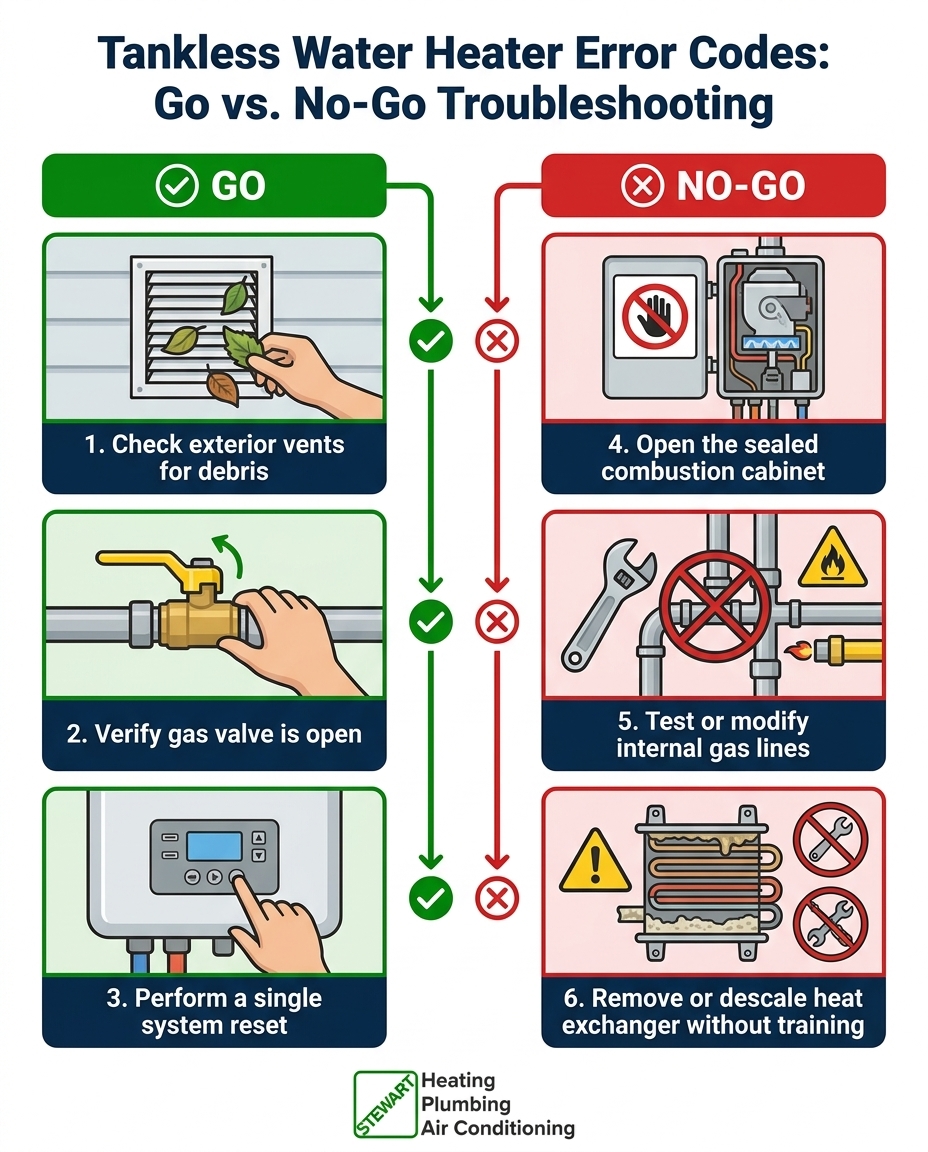
A "safe to reset" condition typically involves external factors that temporarily confused the sensors. If you find a pile of leaves blocking the exterior exhaust vent, clear it away. If you realize the gas valve was accidentally bumped to the closed position, open it. In these specific scenarios, power-cycling the unit once to clear the code is perfectly safe.
Conversely, a "no-go" boundary involves anything inside the unit's casing. You must never attempt DIY access to gas lines, open the sealed combustion cabinet, or modify the heat exchangers. If you perform a single system reset and the exact same error code returns immediately upon turning on a faucet, you are dealing with a hard diagnostic code. Ignoring persistent codes by repeatedly unplugging and resetting the unit will force the system to operate under unsafe conditions, inevitably leading to permanent component damage.
Before you pick up the phone, take a few minutes to verify the external factors. This simple checklist can save you from calling a technician for a non-mechanical issue.
1. Check the exterior vents: Walk outside and visually inspect the intake and exhaust pipes. Ensure they are completely free of cobwebs, leaves, dust buildup, or yard debris.
2. Verify the gas supply: Check other gas appliances in your home, like a stove or furnace. If they are also failing to ignite, you have a house-wide gas supply issue, not a water heater problem.
3. Ensure proper power: Verify the unit is plugged in securely and that the dedicated circuit breaker has not tripped.
4. Perform a single reset: Consult your manufacturer's manual to perform one proper system reset. If the code clears and hot water returns, monitor the unit. If the code flashes again, stop immediately.
When you hit a "no-go" boundary, bringing in a professional is the only safe and effective way to restore your hot water. Professional diagnostics go far beyond simply reading the code on the screen. A certified technician utilizes specialized tools to test the actual mechanical components the code points to. They use digital manometers to verify precise gas pressure drops, multimeters to check the electrical continuity of wiring harnesses, and specialized probes to safely inspect internal sensors without compromising the sealed combustion chamber.
A true mechanical failure requires this level of specialized training to resolve properly without voiding your manufacturer's warranty. Working with our family-owned team at Stewart Heating, Plumbing and Air Conditioning—serving Contra Costa County since 1974—means you are getting diagnostics rooted in decades of hands-on experience, not guesswork. Honest professional diagnostics clearly differentiate between a part that simply needs a thorough cleaning—like a dusty fan motor or a carbon-coated flame rod—and a part that has fundamentally failed and requires replacement.
Whether you are dealing with a simple airflow restriction in Pittsburgh CA or a complex ignition failure, having our trusted experts translate those error codes ensures your tankless system is repaired safely, efficiently, and correctly the first time.
Why is my tankless water heater flashing a code?
Your tankless water heater is flashing a code because an internal sensor has detected an operational anomaly and triggered a safety lockout. These codes are specific diagnostic translations of mechanical issues, ranging from restricted airflow to ignition failure. The system shuts down to prevent overheating, gas buildup, or permanent component damage.
What should I do if my tankless water heater is not getting hot?
If your tankless water heater is not getting hot, the first step is to check the digital control panel for any flashing error codes. Next, verify that your home's gas supply is active and that the exterior intake and exhaust vents are clear of debris. If the unit still refuses to heat after a single reset, you need a professional to inspect the internal ignition and flow sensors.
Is it safe to reset a tankless water heater?
It is safe to perform a single reset on your tankless water heater to clear a temporary glitch or after you have resolved an external issue like a blocked vent. However, if the code returns immediately after the reset, it is not safe to continue resetting the unit. Repeatedly forcing a locked-out system to run can cause permanent damage to the heat exchanger or control board.
How do I reset my tankless water heater?
The standard way to reset a tankless water heater is to turn off all hot water taps, locate the power button on the digital control panel, and turn the unit off and back on. Alternatively, some models require you to unplug the unit from the wall outlet for 30 seconds before plugging it back in. Always consult your specific manufacturer's manual for the exact reset procedure for your model.
What causes a tankless water heater to stop heating?
A tankless water heater stops heating when the internal computer interrupts the gas supply due to a safety concern. Common causes include a dirty flame rod failing to detect ignition, scale buildup insulating the heat exchanger, or a clogged inlet filter restricting water flow below the activation threshold. Any of these issues will prompt the unit to abort the heating cycle.
Are diagnostic error codes the same across all tankless brands?
No, diagnostic error codes are not universal and vary significantly between different tankless water heater manufacturers. While an "Ignition Failure" is a common problem, the specific two- or three-digit code used to indicate it will look different on a Navien, Rinnai, or Takagi unit. You must cross-reference the specific code with your brand's technical manual to determine the exact cause.
Dealing with a sudden loss of hot water and confusing error codes is stressful, but you do not have to decipher the problem alone. When your system locks out and a simple reset doesn't work, trust the experts to pinpoint the mechanical issue safely. Reach out today for professional diagnostics and a definitive go/no-go guide on restoring your home's comfort.

Very professional and complete. I would recommend Stewart to anyone. Highest quality of workmanship and clean installation.
Stewart Heating Plumbing Air Conditioning just did some work for us for the first time. They did an installation at my home and it turned out well. I thought the price was fair and I definitely would use them again. The technicians were very friendly and knowledgeable about their work. I highly recommend Stewart Heating Plumbing Air Conditioning and already told friends to use them.
We have been using Stewart Heating Plumbing Air Conditioning since 1995. They put the original heating and air unit in the house, and we have just stayed with them. They are dependable and honest people, and they have done a good job for us every time that we have used them!
They came and did an inspection and are coming tomorrow to do the repair.
They replaced a regulator the first time, and then the water heater vent had to be replaced. They did great work.
The gentleman that serviced us was helpful, insightful, and knew what he was talking about. Overall, it was a great experience.