

Recent Blogs
Stay updated with our latest blog posts.

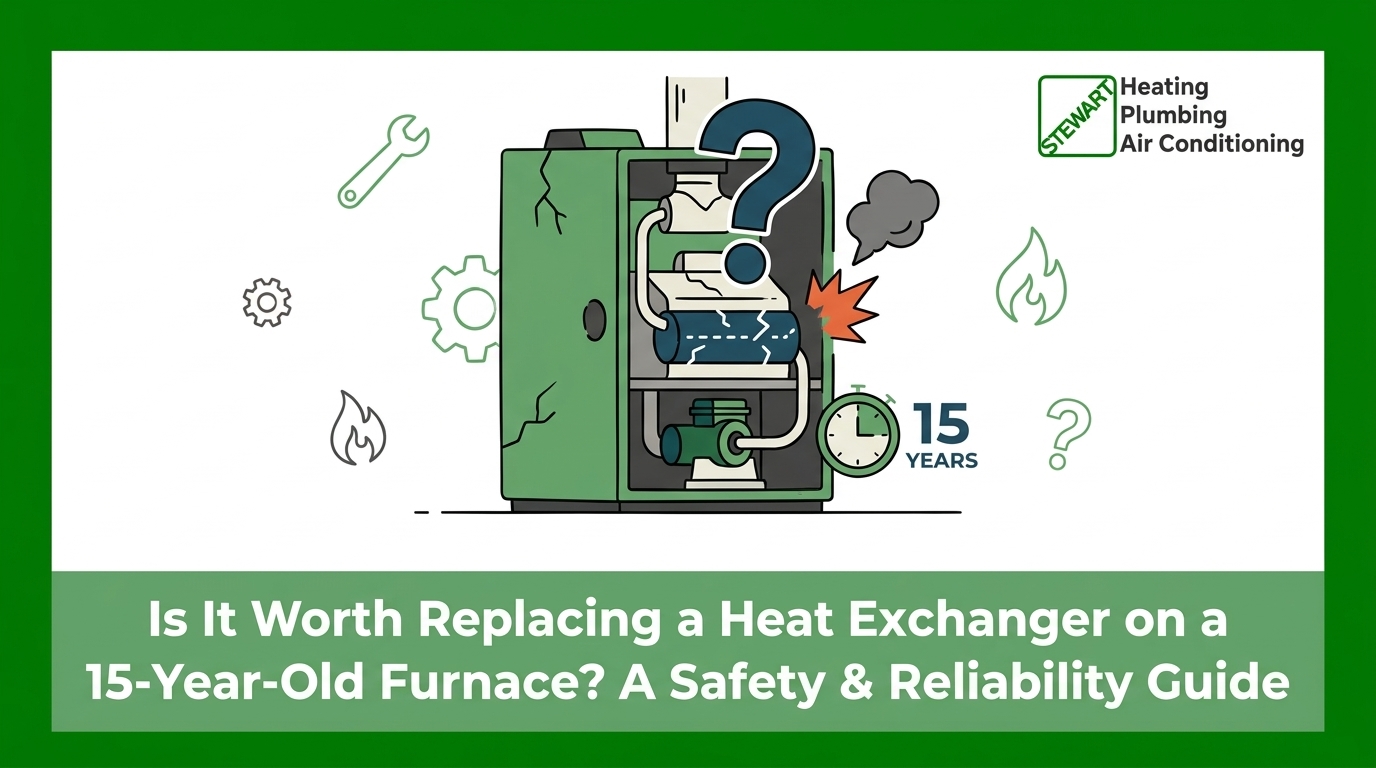
If you find yourself asking, "Is it worth replacing a heat exchanger on a 15-year-old furnace?" you are likely facing a stressful decision right as the weather begins to turn. In our 50-plus years serving Pittsburg, CA, a common pattern our team at Stewart Heating, Plumbing and Air Conditioning sees is a homeowner scheduling an early fall pre-heating season tune-up, expecting a simple filter change and a clean bill of health, only to have our technician discover a cracked heat exchanger. Suddenly, a routine maintenance visit turns into a major, unexpected home decision.
Discovering this level of structural failure on an aging heating system forces a difficult choice: do you attempt to replace the broken component, or do you upgrade the entire unit? Making this choice requires looking beyond the immediate repair. It requires a comprehensive framework that evaluates the safety of your household, the long-term reliability of the equipment, and the overall age of the system. If you are evaluating your options, our team provides comprehensive professional HVAC services to help you make the safest choice for your family's comfort.
When our technicians are asked this question, our direct answer is almost universally no; replacing a heat exchanger on a 15-year-old furnace is generally not recommended. To understand why, you have to look at the expected lifespan of residential heating equipment. The average gas furnace is engineered to last between 15 and 20 years. When a system reaches the 15-year mark, it has already entered the final stage of its functional lifecycle.
Replacing this specific component is not a simple, hour-long task. The heat exchanger is the literal core of the furnace. To replace it, our technicians must completely dismantle the unit. They have to disconnect the gas lines, remove the burner assembly, pull out the blower compartment, and extract the heavy, damaged metal core before reversing the entire process to install the new one. This highly labor-intensive process requires hours of meticulous work.
Sinking this level of labor into a unit that is already at the end of its 15-year-old system lifespan is widely considered an impractical investment. Instead of applying a temporary patch to an expiring machine, a fresh installation provides guaranteed reliability, ensuring your home stays warm without the looming threat of the next breakdown. If you are facing this diagnosis, exploring a complete heating replacement and installation is typically the most logical and financially sound path forward.
• Expected Lifespan — Repairing the Heat Exchanger: Adds a few years to an expiring system — Replacing the 15-Year-Old Furnace: Provides 15–20 years of reliable operation
• Warranty Coverage — Repairing the Heat Exchanger: May cover the part, but rarely the extensive labor — Replacing the 15-Year-Old Furnace: Includes comprehensive new parts and labor warranties
• Energy Efficiency — Repairing the Heat Exchanger: Remains at the outdated, 15-year-old efficiency level — Replacing the 15-Year-Old Furnace: Upgrades to modern, high-efficiency AFUE standards
• Safety Confidence — Repairing the Heat Exchanger: Fixes the immediate crack, but old components remain — Replacing the 15-Year-Old Furnace: Guaranteed fresh start with zero metal fatigue
To fully grasp why our heating specialists stress that a cracked heat exchanger cannot be ignored or delayed, you must understand its mechanical function. The heat exchanger acts as a critical, sealed barrier inside your furnace. When the burners ignite, they create intense heat and toxic combustion gases, including carbon monoxide (CO), sulfur dioxide, and nitrous oxide. These dangerous gases travel inside the sealed metal chambers of the heat exchanger.
Meanwhile, your blower motor pulls cold air from your home and pushes it over the outside of these hot metal chambers. The heat transfers to the air, which is then circulated through your vents to warm your rooms. The toxic exhaust gases remain safely trapped inside the metal and are eventually vented out through your roof or side wall. However, when a crack develops in that metal—even a microscopic hairline fracture—that vital seal is broken.
A compromised heat exchanger allows colorless, odorless carbon monoxide to leak directly into the breathable air circulating through your living space. Because CO cannot be seen or smelled, a cracked heat exchanger is widely recognized as one of the most critical safety hazards in a residential home.
Heat exchanger cracks rarely announce themselves. Without a dedicated diagnostic check, these fractures can easily go unnoticed until they trigger a carbon monoxide detector alarm—and by that point, the toxic gas is already inside your home. Professional tools, such as the specialized combustion analyzers and high-definition inspection cameras our teams use, are required to identify hairline fractures before the constant expansion and contraction of winter heating widens them further.
This is why timely inspections are so vital. For example, during an early fall pre-heating season check last year, one of our local Pittsburg homeowners requested a thorough evaluation of their aging unit. Our Stewart Heating technician performed an extremely thorough and professional check of the internal components, identifying hidden wear before the cold weather set in. The customer felt entirely confident in the system's safety status afterward. Scheduling a comprehensive preventative maintenance plan is the most reliable way to catch these invisible dangers before they threaten your household.
When evaluating a major HVAC repair, the status of the manufacturer's warranty plays a massive role in the decision-making process. Standard residential furnace warranties are typically divided into two categories: a general parts warranty (which covers motors, boards, and valves) and a specific heat exchanger warranty.
While some manufacturers offer 20-year or even "lifetime" warranties on the heat exchanger part itself, these warranties almost always come with significant caveats. By the 15-year mark, general parts warranties have long since expired. Furthermore, even if the heat exchanger part is technically still under warranty, the coverage strictly applies to the metal component itself—not the labor required to install it. As established earlier, the labor required to dismantle and rebuild a furnace is extensive. Without warranty coverage for that labor, the homeowner bears the full, heavy burden of the repair costs.
Stewart Heating, Plumbing and Air Conditioning has been serving the community since 1974. With over 50 years of experience, we have seen countless homeowners regret sinking funds into out-of-warranty systems. The frustration of paying for a massive labor bill on a 15-year-old system lifespan, only to have a different expensive part fail the following winter, is a common reality we try to help our customers avoid. Contrasting this with the comprehensive peace of mind provided by a brand-new manufacturer warranty on a replacement unit makes the path forward much clearer.
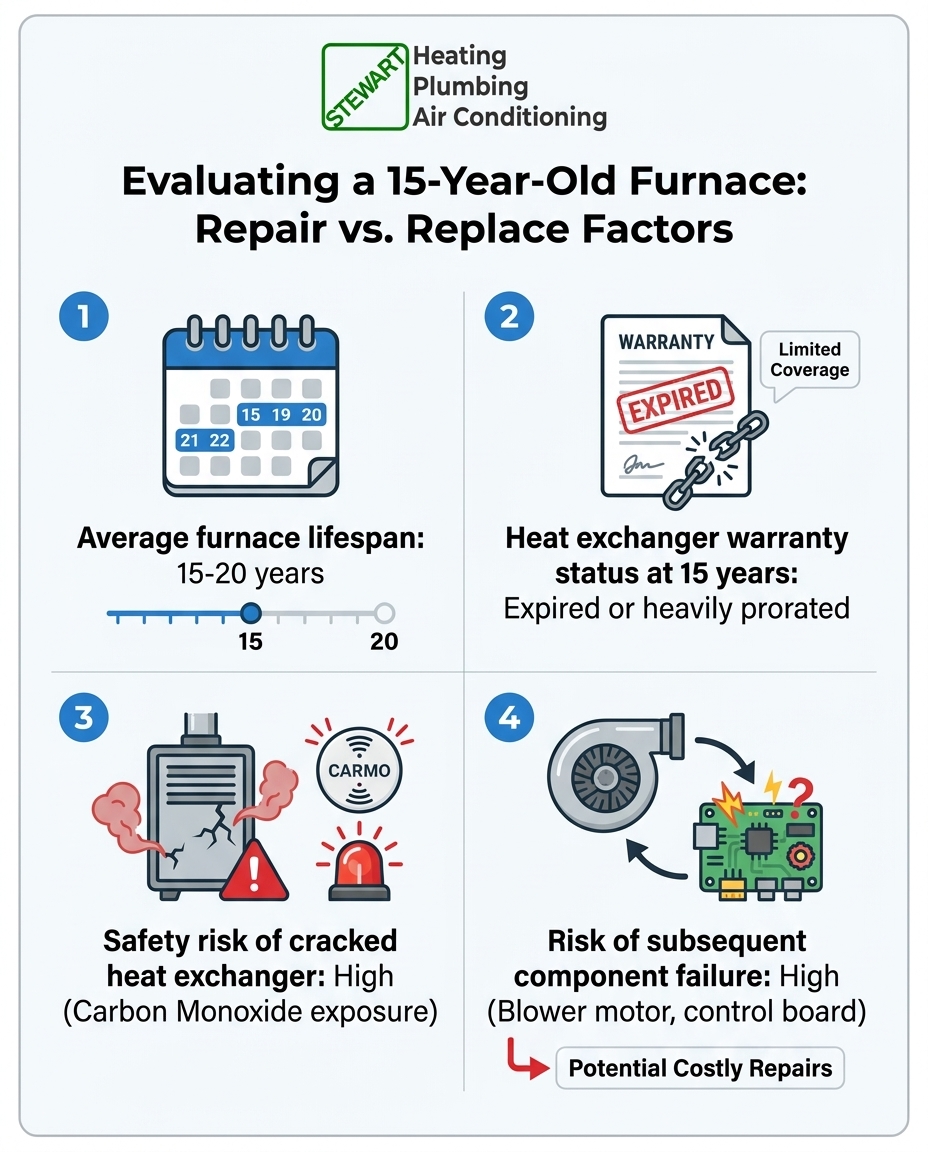
It is tempting to view a cracked heat exchanger as an isolated incident—a single broken part that just needs to be swapped out. However, in a machine that relies on a sequence of integrated operations, a cracked heat exchanger is usually a glaring symptom of overall system fatigue. When a furnace reaches its 15-year-old system lifespan, the metal has expanded and contracted thousands of times. If the core has failed, the surrounding components are likely not far behind.
At Stewart Heating, Plumbing and Air Conditioning, we often refer to this as the "domino effect" of aging HVAC equipment. Fixing the immediate issue simply resets the clock until the next major, non-warrantied component breaks down. When evaluating the health of the entire system, you must consider the other critical parts that typically fail around the 15-year mark:
• The Blower Motor: This heavy-duty fan works tirelessly to circulate air throughout your ductwork. After 15 years, the bearings begin to wear down, leading to motor failure or electrical shorts.
• The Inducer Draft Motor: Before the burners even ignite, this smaller motor starts up to clear residual gases from the heat exchanger. It runs constantly during the heating cycle and is highly susceptible to wear and tear.
• The Main Control Board: The electronic "brain" of your furnace manages the sequence of operations. Over a decade and a half, the constant exposure to heat and vibration causes the electronic relays to degrade and eventually fail.
• The Smart Gas Valve: This component precisely regulates the flow of fuel to the burners. Mechanical wear over 15 years can cause it to stick, resulting in a "no heat" situation.
If you choose to rebuild the furnace around a new heat exchanger, you might find yourself reading up on repairing vs. replacing failing HVAC components just months later when the blower motor suddenly seizes. Looking at the holistic health of the system prevents you from throwing good money after bad.
Beyond safety and reliability, there is a significant financial upside to replacing an aging system: energy efficiency. Furnaces are measured by their Annual Fuel Utilization Efficiency (AFUE) rating. If your 15-year-old furnace was rated at 80% AFUE when it was brand new, that meant 80 cents of every energy dollar went into heating your home, while 20 cents was wasted as exhaust. After 15 years of wear, that functional efficiency has likely dropped even lower.
Modern, high-efficiency models can achieve AFUE ratings of up to 98%, meaning nearly all the energy you pay for is converted directly into heat. Furthermore, modern replacements often qualify for generally applicable energy rebates or federal tax credits. Whether you opt for a high-efficiency gas furnace or a modern heat pump upgrade, we advise readers to verify current generic programs with their utility provider or a tax professional to maximize their investment.
There is also a critical logistical urgency to making this decision during the early fall pre-heating season. In our decades of keeping Pittsburg, CA and the broader East Bay region warm, we know firsthand how quickly chilly winter nights and rapid temperature drops can arrive. A reliable heating source is absolutely essential for evening safety. If you patch an old system and experience a sudden, total secondary failure in the middle of a cold winter night, you will be left scrambling for emergency service when local HVAC schedules are completely booked.
Proactive replacement changes that narrative entirely. For instance, one local family we worked with realized their aging system was failing just as winter set in. Our technicians were dispatched the day before Christmas, successfully installing the new furnace and having it online by the end of the day. Because they made the call to replace rather than endure a risky repair, their house was safely and consistently heated for their holiday family gathering.
A furnace heat exchanger generally lasts between 15 and 20 years, which aligns directly with the expected lifespan of the furnace itself. Because it endures constant thermal expansion and contraction every time the burners ignite, the metal eventually fatigues and cracks as it approaches the two-decade mark. Routine maintenance can help it reach its maximum lifespan, but it will not last forever.
Yes, a cracked heat exchanger is highly dangerous and is considered a severe residential safety hazard. The crack breaks the seal that separates toxic combustion exhaust from your home's breathable air, allowing colorless, odorless carbon monoxide to leak into your living space. If a crack is discovered, the furnace should be shut down immediately until it is repaired or replaced.
Technically yes, the heat exchanger component itself can be removed and replaced with a new one. However, it is a highly labor-intensive process that requires completely dismantling the furnace. Because of the extensive labor involved and the likelihood of other parts failing soon, our HVAC professionals do not recommend this repair for older, out-of-warranty units.
Symptoms can include strange formaldehyde-like odors, visible soot buildup around the furnace, a yellow burner flame instead of blue, or carbon monoxide detector alarms sounding. However, many microscopic cracks show absolutely no obvious symptoms to the homeowner. Identifying these hidden fractures requires professional diagnostic tools and visual inspection cameras during a routine tune-up.
If your 15-year-old furnace requires a major, labor-intensive repair like a heat exchanger replacement, installing a brand-new furnace is the safest and most reliable long-term choice. Sinking significant funds into a system that has already reached the end of its functional life is rarely a good investment. A new system provides higher efficiency, guaranteed safety, and comprehensive manufacturer warranties.
When you ask, "Is it worth replacing a heat exchanger on a 15-year-old furnace?" the facts clearly point toward replacement as the most logical and secure step. Facing a cracked heat exchanger is daunting, but prioritizing safety, long-term value, and guaranteed reliability will always lead you to the best outcome for your home. By choosing to upgrade a unit that has already reached its 15-year-old system lifespan, you eliminate the severe risks of carbon monoxide exposure and the frustration of impending secondary breakdowns.
While investing in a new heating system is a significant decision, it brings immense peace of mind, brand-new warranties, and vastly improved energy efficiency. Don't wait for a patched system to fail on the coldest night of the year. Our team at Stewart Heating, Plumbing and Air Conditioning encourages you to consult with us to explore your replacement options during the early fall pre-heating season, ensuring your family stays safe, warm, and comfortable all winter long.

Very professional and complete. I would recommend Stewart to anyone. Highest quality of workmanship and clean installation.
Stewart Heating Plumbing Air Conditioning just did some work for us for the first time. They did an installation at my home and it turned out well. I thought the price was fair and I definitely would use them again. The technicians were very friendly and knowledgeable about their work. I highly recommend Stewart Heating Plumbing Air Conditioning and already told friends to use them.
We have been using Stewart Heating Plumbing Air Conditioning since 1995. They put the original heating and air unit in the house, and we have just stayed with them. They are dependable and honest people, and they have done a good job for us every time that we have used them!
They came and did an inspection and are coming tomorrow to do the repair.
They replaced a regulator the first time, and then the water heater vent had to be replaced. They did great work.
The gentleman that serviced us was helpful, insightful, and knew what he was talking about. Overall, it was a great experience.