

Recent Blogs
Stay updated with our latest blog posts.

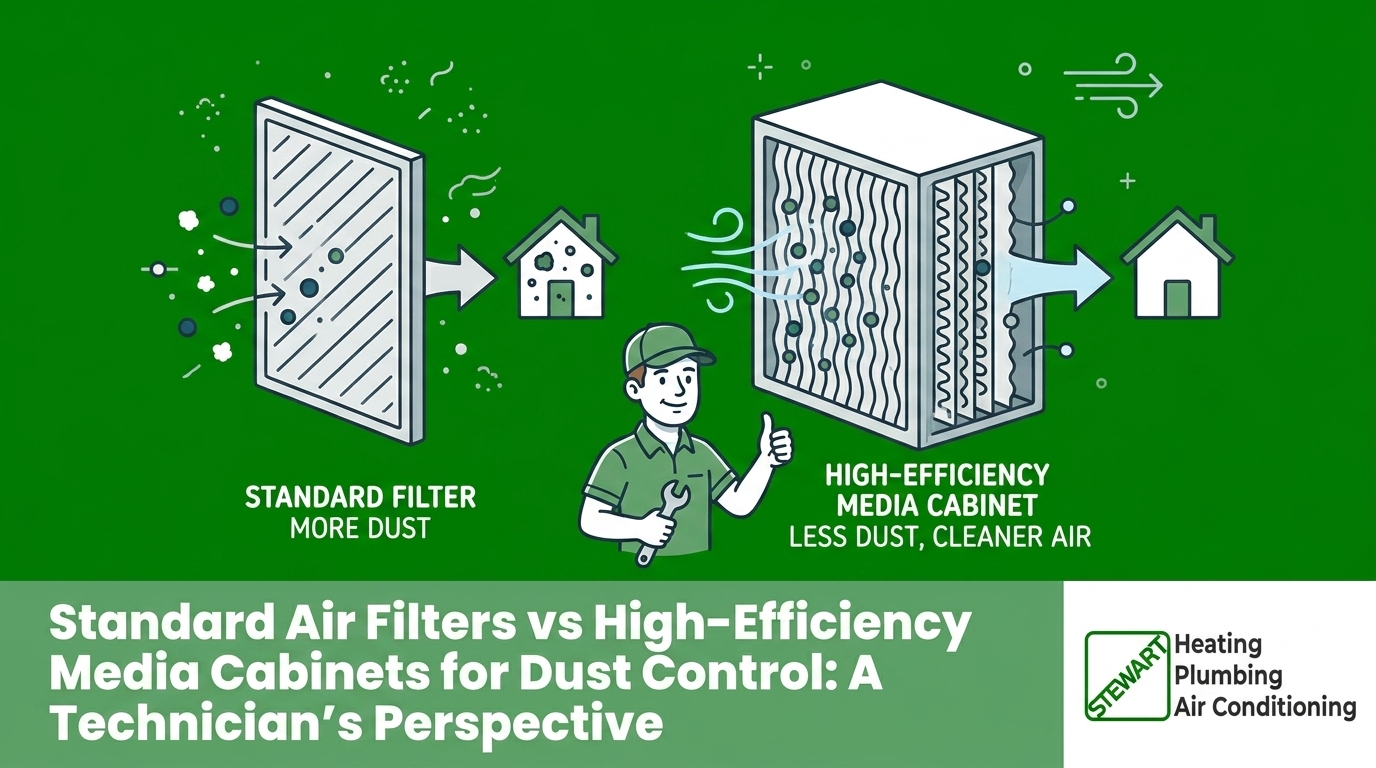
If you are weighing standard air filters vs high-efficiency media cabinets for dust control, you might think buying the most expensive, highest-MERV 1-inch filter at the hardware store is the best way to clean your air. Homeowners often assume that a denser filter automatically means better indoor air quality. However, our team at Stewart Heating, Plumbing and Air Conditioning knows this common misconception can actively damage your equipment. During peak summer July heatwaves, your cooling system needs to move a massive volume of air to keep your Pittsburgh CA home comfortable. When you install a highly restrictive 1-inch filter, it acts more like a solid wall than a breathable sieve.
This extreme restriction leads to significant dust bypass. Because the air cannot push through the dense pleated material, it forces its way around the cardboard edges of the filter, dragging dirt and debris directly into your equipment. What our technicians typically find inside ductwork is that good intentions often lead to frozen coils. A choked blower motor simply cannot pull enough warm indoor air over the evaporator coil, causing the condensation on the coil to freeze solid. You are left facing a critical decision point: continuing to replace standard 1-inch filters every single month and hoping for the best, or upgrading your ductwork to accommodate a high-efficiency media cabinet that actually supports proper airflow.
If you are looking to improve your Indoor Air Quality and protect your equipment from unnecessary summer strain, understanding the mechanics of airflow is the first step.
The fundamental limitation of a standard 1-inch filter is its severe lack of surface area. To understand why this matters, you have to look at how air moves through your air conditioning system.
When manufacturers create a high-MERV 1-inch filter, they have to pack a tremendous amount of dense filtration material into a very narrow space. Because there is very little room for pleats, the actual surface area of the filter media is quite small. To catch microscopic dust particles, the material must be woven tightly. This tight weave creates a high level of static pressure—meaning your blower motor has to work incredibly hard just to pull air through the filter. Our technicians often compare it to trying to run a summer marathon while breathing through a heavy wool blanket.
Your cooling system is engineered to operate within a specific static pressure range. When you exceed that limit with a restrictive 1-inch filter, the volume of air circulating through your home drops significantly. You will likely notice weak airflow at your vents, warm spots in certain rooms, and a system that runs non-stop without ever satisfying the thermostat. The filter might be catching dust, but it is doing so by suffocating the very system designed to keep you cool.
A 4-inch media cabinet solves this mechanical problem by relying on deep pleats to drastically increase the total surface area. If you were to take the filter media out of a 4-inch cabinet and stretch it flat, it would cover significantly more square footage than a 1-inch filter. This expanded surface area allows the filter to use high-efficiency, tightly woven material without increasing static pressure. The air has plenty of room to pass through, ensuring your blower motor can breathe easily while still capturing microscopic dust particles and allergens.
Local environmental factors create a unique stress test for residential cooling systems, making proper filtration even more important for homeowners in Pittsburgh CA and the surrounding East Bay area.
In our years of serving the East Bay, we have seen how our specific climate challenges quickly overwhelm standard filtration setups. The dry, dusty summer conditions mean your return ducts are constantly pulling in high volumes of particulate matter. When you add seasonal wildfire smoke to the mix, the air entering your system is loaded with microscopic ash and soot that standard filters simply cannot handle efficiently.
Under these heavy local loads, a standard 1-inch filter will rapidly "blind"—a term our technicians use when the face of the filter becomes completely caked with debris.
• Rapid clogging: Dry dust and smoke particles fill the shallow pleats of a 1-inch filter within weeks, sometimes days during heavy fire seasons.
• Accelerated efficiency loss: Once the filter blinds, airflow plummets, and your system's energy efficiency drops right along with it.
• Increased bypass: The heavy layer of dirt creates so much resistance that the system pulls unfiltered, smoky air through tiny gaps in the filter housing.
To keep your home's air clean during an East Bay summer, you need a filtration system built to handle heavy, continuous particulate loads without blinding prematurely.
In our experience working on Pittsburgh HVAC systems, the damage caused by restrictive 1-inch filters is one of the most common—and preventable—issues we encounter during peak summer July service calls.
Restricted airflow forces your blower motor to work much harder than intended, drawing excess amperage and running hotter than normal. This constant strain accelerates wear and tear on internal electrical components. For example, during a recent July heatwave, one local customer reached out to us when the circuit board in their air conditioning unit malfunctioned. Because the unit was located in an unusual, tight spot, the system was already prone to airflow challenges. The restrictive 1-inch filter they had installed pushed the blower motor past its limits, overheating the system. Our Stewart Heating technician fixed the malfunctioning circuit board and recommended a permanent upgrade to their filter housing to prevent the issue from recurring.
Insufficient air passing over the evaporator coil frequently leads to system freezes during extreme heat. When the coil gets too cold, the condensation freezes into a block of ice, entirely shutting down your cooling capacity. Furthermore, when standard filters clog, the bypassed dust coats the blower wheel and the wet evaporator coil. This creates a thick layer of mud inside your equipment that insulates the coil, further reducing efficiency and requiring a costly deep cleaning to restore performance. Knowing the signs your air filter needs changing is helpful, but upgrading the filter housing altogether prevents these hidden costs from adding up.
At Stewart Heating, Plumbing and Air Conditioning, we position media cabinets as your primary defense against dust because it is the definitive solution for high-efficiency filtration that actually protects your cooling system.
1. Superior Particle Capture: Media cabinets are designed to capture up to 99% of airborne particles. The deep-pleated media traps fine dust, pet dander, and seasonal wildfire smoke far more effectively than standard 1-inch fiberglass or cheap pleated filters.
2. Maintained Static Pressure: Because of the massive difference in 1-inch vs 4-inch filter surface area and airflow restriction, the deep-pleated design maintains optimal static pressure. Your system breathes easily, ensuring the blower motor operates within its safe design limits even when the filter is collecting heavy dust.
3. Extended Replacement Intervals: A standard 1-inch filter needs to be replaced every 30 days during peak summer use. In contrast, a 4-inch media cabinet provides extended replacement intervals—often lasting 6 to 12 months. This means less hassle for you and more consistent, reliable protection for your equipment.
4. Sustained Energy Efficiency: Proper filtration directly translates to sustained energy efficiency. When your system can move air freely, it cools your home faster and cycles off sooner, reducing your monthly energy consumption and preventing unexpected breakdowns.
Upgrading your filtration setup provides significant peace of mind. During a particularly smoky summer week, another customer asked for our help because their family was struggling with poor indoor air quality despite changing their 1-inch filter constantly. Our technician evaluated their home's airflow, recommended a new high-efficiency media cabinet alongside a system tune-up, and left the customer feeling informed and protected. That level of comprehensive protection applies strongly during the heavy cooling demands of summer.
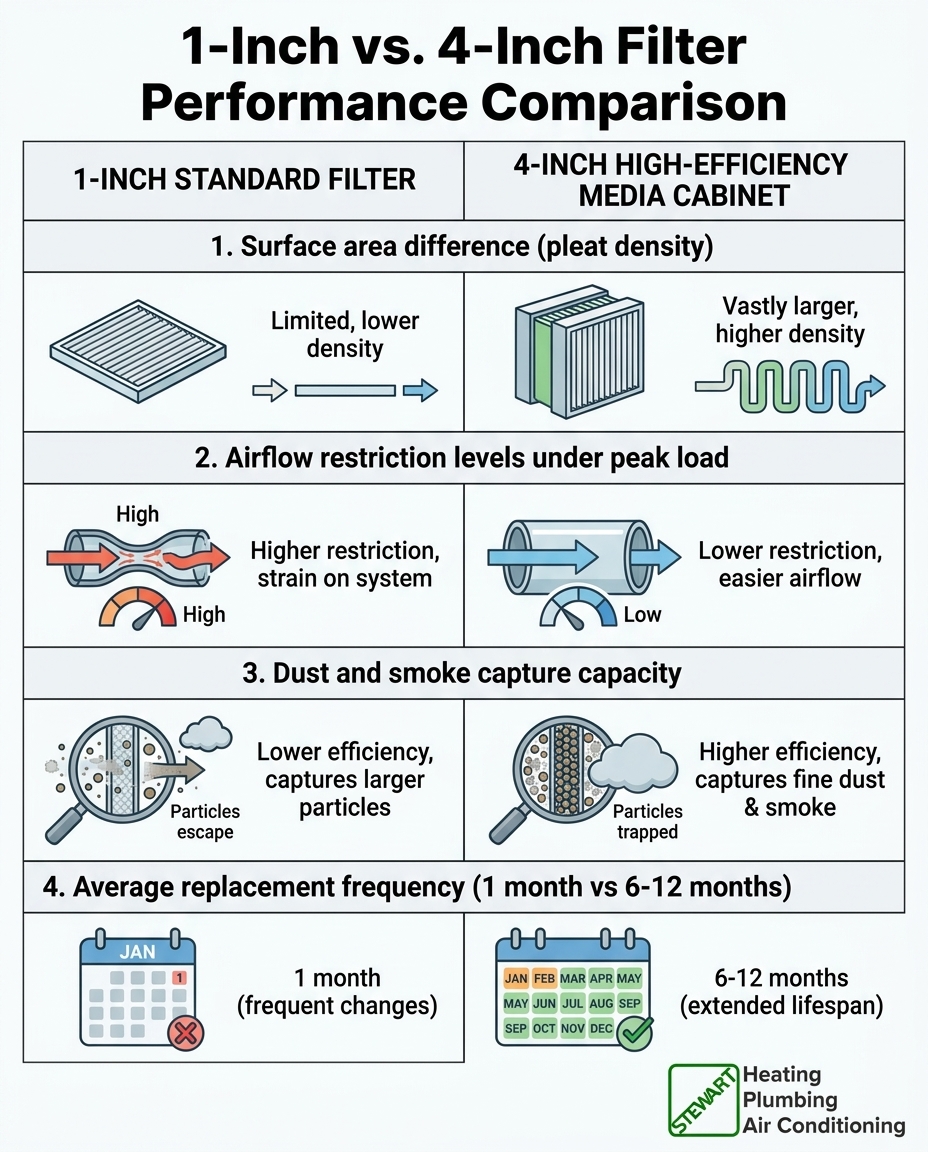
To help you see the mechanical differences clearly, here is a direct breakdown of how these two filtration methods perform under pressure.
• Airflow Restriction — 1-Inch Standard Filter: Creates dangerously high restriction when MERV rating is increased. — 4-Inch Media Cabinet: Maintains low static pressure due to massively expanded surface area.
• Dust Capacity — 1-Inch Standard Filter: Minimal capacity; shallow pleats blind and clog very quickly. — 4-Inch Media Cabinet: High capacity; deep pleats hold significantly more particulate matter.
• System Strain — 1-Inch Standard Filter: Elevates the risk of frozen evaporator coils and overheated motors. — 4-Inch Media Cabinet: Protects blower motors and keeps coils clean from bypassed dust.
• Replacement Frequency — 1-Inch Standard Filter: Requires monthly changes during heavy summer or smoke use. — 4-Inch Media Cabinet: Lasts up to a full year, depending on local environmental factors.
Transitioning to a better filtration system is an excellent investment, but it requires more than just buying a thicker filter at the store. Upgrading to a media cabinet is not a simple slide-in replacement; it requires modifying your return air ductwork.
The Modification Process: The existing narrow filter track must be removed, and a wider, custom-fitted metal cabinet must be permanently installed into the duct system. This professional modification ensures an airtight seal between the return drop and the furnace or air handler. An airtight cabinet prevents the severe dust bypass that is so common with flimsy, leaky 1-inch filter tracks.
Sizing and Airflow: Consulting with an expert ensures the new cabinet is sized correctly for your system's specific airflow requirements. If the cabinet is too small, you will still face restriction issues. A proper installation is a direct investment in the longevity of your entire cooling system, ensuring that the heavy dust of Pittsburgh CA stays out of your expensive mechanical components.
By relying on professional HVAC services to handle the ductwork modification, you guarantee that your new filtration setup will perform exactly as designed, providing clean air without suffocating your equipment.
Yes, they can severely restrict airflow, leading to frozen evaporator coils and overworked blower motors. Because they lack surface area, the dense material required to achieve a high MERV rating acts like a wall inside your ductwork. Over time, this restriction forces your system to run longer, drives up your energy bills, and accelerates wear and tear on internal components.
The deep pleats provide massively more surface area, allowing the filter to hold significantly more dust before airflow is compromised. Instead of the dust piling up on a flat, shallow surface and immediately blocking the air, the particles spread out across the deep folds of the media. This expanded capacity allows the filter to function effectively for 6 to 12 months rather than just 30 days.
Absolutely. It captures finer particles without suffocating the system, and the airtight cabinet prevents dust from bypassing the filter. Standard 1-inch filter slots often leak air around the cardboard edges, allowing dirt to get sucked directly into the blower. A professionally installed media cabinet locks tight, ensuring that 100% of the air passing through your ducts is actually being filtered.
Not directly. The ductwork must be professionally modified to accommodate the wider housing of a media cabinet. You cannot simply squeeze a 4-inch filter into a 1-inch slot. A technician needs to cut into the return air drop, install the heavy-duty metal cabinet, and seal it completely to ensure proper system performance.
While they can last up to a year, it is wise to inspect them every 6 months, especially during seasons with heavy dust or smoke. If you live in an area prone to summer wildfires or heavy dry winds, the filter will load up faster than average. Pulling the filter out for a quick visual check twice a year ensures you never accidentally choke your system's airflow.
Better filtration should never come at the cost of your cooling performance. Upgrading from a restrictive 1-inch filter to a high-efficiency media cabinet solves both your indoor dust control challenges and the mechanical airflow issues that plague systems during peak summer July heat. You do not have to choose between breathing clean air and keeping your evaporator coils from freezing solid. A professional assessment from our team can determine the exact filtration strategy needed to support your specific equipment. If you are ready to stop fighting with monthly filter changes and want to ensure your system runs smoothly all season long, enrolling in a comprehensive HVAC maintenance plan is the smartest way to keep your home comfortable and your air quality pristine.

Very professional and complete. I would recommend Stewart to anyone. Highest quality of workmanship and clean installation.
Stewart Heating Plumbing Air Conditioning just did some work for us for the first time. They did an installation at my home and it turned out well. I thought the price was fair and I definitely would use them again. The technicians were very friendly and knowledgeable about their work. I highly recommend Stewart Heating Plumbing Air Conditioning and already told friends to use them.
We have been using Stewart Heating Plumbing Air Conditioning since 1995. They put the original heating and air unit in the house, and we have just stayed with them. They are dependable and honest people, and they have done a good job for us every time that we have used them!
They came and did an inspection and are coming tomorrow to do the repair.
They replaced a regulator the first time, and then the water heater vent had to be replaced. They did great work.
The gentleman that serviced us was helpful, insightful, and knew what he was talking about. Overall, it was a great experience.