

Recent Blogs
Stay updated with our latest blog posts.

If you find yourself asking, "Why is my AC evaporator coil freezing up in late August?" you are dealing with one of the most frustrating timing issues a homeowner can face. The late-summer / back-to-school transition is stressful enough without your home feeling like a sauna while an actual block of ice forms on your HVAC system. It often feels like a sudden, catastrophic breakdown. However, in our team's experience responding to late-season service calls across Pittsburgh, CA, a frozen air conditioner at the end of the summer is rarely a sudden event. Instead, it is usually the culmination of weeks of heavy, continuous system operation.
With the intense afternoon heat spikes typical of late August in the East Bay, cooling systems are forced to run almost nonstop. This constant demand pushes your equipment to its absolute limit. You are now at a critical decision point: determining if your system simply needs a thorough thaw and a fresh air filter, or if you require a licensed professional to diagnose a deeper mechanical failure. Taking the right steps immediately can save your compressor from permanent damage.
Need immediate help right now? Reach out to our team at Stewart Heating, Plumbing and Air Conditioning for expert air conditioning services to get your home comfortable again.
To understand late August AC freezing, our technicians often explain to customers that we have to look past the basic mechanics of how an air conditioner works and examine the cumulative strain of 60 to 90 days of heavy summer cooling cycles. Your air conditioner does not actually create cold air; it removes heat from the existing air inside your home. It does this by blowing warm indoor air over the cold evaporator coil, which absorbs the heat and carries it outside.
This heat transfer process requires a very specific volume of air. A standard residential air conditioning system requires approximately 400 cubic feet per minute (CFM) of airflow per ton of cooling capacity. When the system operates normally, the continuous flow of warm air keeps the evaporator coil at a stable temperature—usually around 40 degrees Fahrenheit. The condensation that naturally forms on the coil simply drips away as water.
However, when airflow is severely restricted, there is not enough warm air crossing the coil to provide the necessary heat. Without that heat absorption, the temperature of the refrigerant inside the coil plummets rapidly.
When the coil temperature drops below 32 degrees Fahrenheit, the ambient condensation on the metal fins instantly turns to solid ice. This creates a cascading failure: the ice itself acts as an insulator and a physical barrier, further blocking airflow and causing the ice layer to grow thicker with every passing minute.
• Normal Operation — Airflow Volume: Optimal (~400 CFM/ton) — Coil Temperature: ~40°F (Above Freezing) — Condensation State: Liquid water (drips into pan)
• Mild Restriction — Airflow Volume: Reduced — Coil Temperature: 33°F - 38°F — Condensation State: Heavy condensation, sluggish cooling
• Severe Restriction — Airflow Volume: Critically Low — Coil Temperature: Below 32°F — Condensation State: Solid ice formation
By the time late August arrives, our service crews often find that minor airflow restrictions that started in June have compounded into major blockages, setting the stage for a complete system freeze.
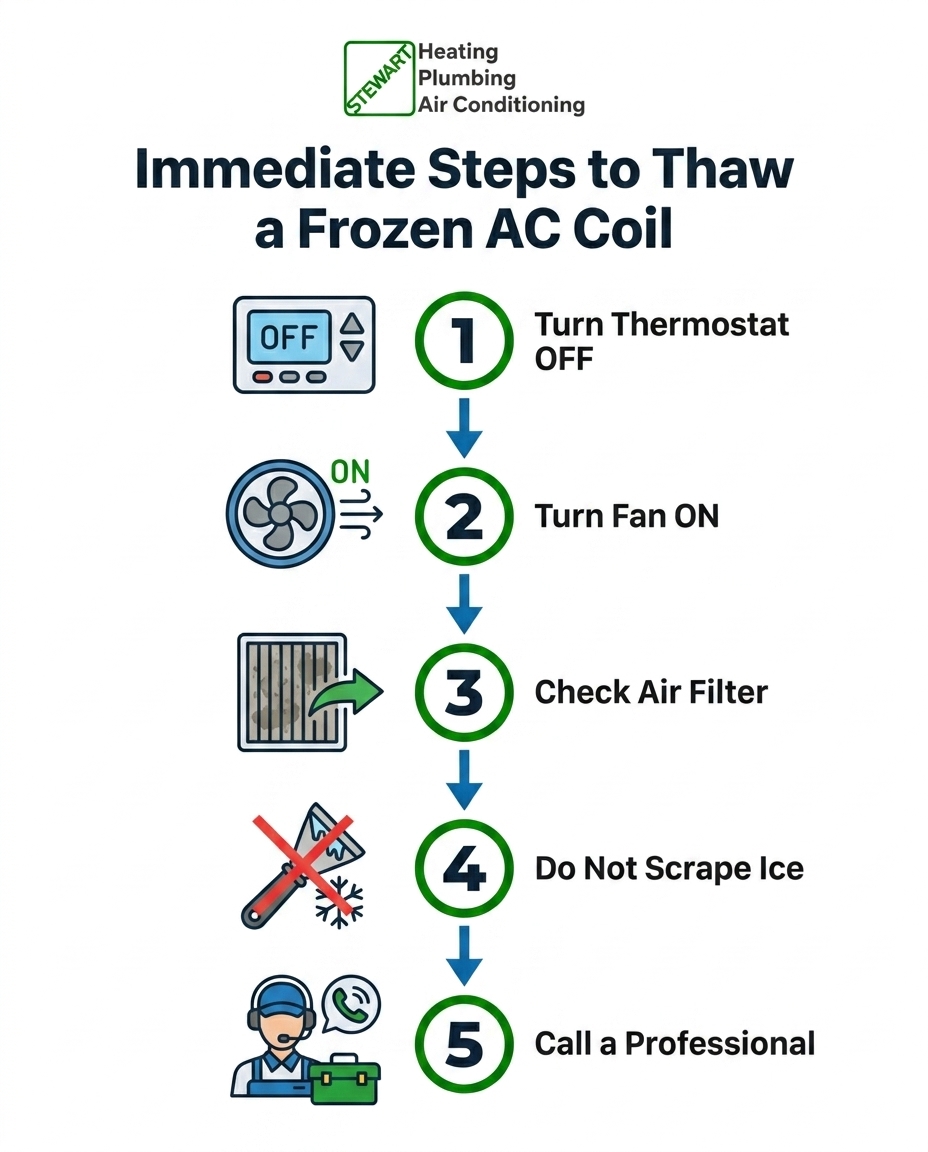
Discovering a frozen unit during the late-summer / back-to-school transition is alarming, but how you react dictates whether the system survives. Taking the correct immediate actions will protect your expensive compressor and prepare the unit for proper troubleshooting by our technicians.
1. Turn the thermostat completely OFF: This is your most critical first step. Stop the cooling cycle immediately. If you leave the air conditioner running while the coil is frozen, liquid refrigerant can flow backward into the compressor. This is called "slugging," and it can permanently destroy the compressor motor.
2. Turn the fan setting to ON: Switch your thermostat's fan setting from "Auto" to "On." This forces the indoor blower motor to run continuously, circulating warm indoor air over the frozen coil to accelerate the melting process safely.
3. Check the air filter immediately: Locate your return air filter and pull it out. If it is caked with dust, pet hair, or debris, it is highly likely the primary cause of your freeze-up. Replace it with a clean filter, but leave the system off until the ice is gone.
4. Never attempt to chip or scrape the ice: The aluminum fins on your evaporator coil are incredibly delicate and house highly pressurized refrigerant. Poking the ice with a knife or screwdriver can easily puncture the coil, turning a simple airflow issue into a catastrophic system replacement.
5. Call a professional: While the system thaws—a process that can take anywhere from a few hours to a full day—contact our licensed technicians to schedule a diagnostic visit.
The most common and easily solvable cause of late-season freeze-ups we encounter in Pittsburgh is severe airflow restriction stemming from dirty air filters. Homeowners often start the summer with good intentions, installing a fresh filter in June. But as the back-to-school season approaches and schedules get busy, that filter is forgotten.
Throughout the summer, your HVAC system pulls in massive amounts of airborne particles. Dust, pet dander, pollen, and cooking airborne grease compound inside the filter media. Because systems run longer and more frequently in Pittsburgh, CA during the peak heat, a filter that looked perfectly fine in early July can become completely choked and impassable by late August.
Many homeowners view air filters strictly as a health feature, but their primary job is to protect the mechanical components of the blower and coil. Poor indoor air quality and filtration directly impact the physical performance of your HVAC system. When the filter media is clogged, the blower motor has to work twice as hard to pull air through, which drops the overall CFM below the minimum threshold required to keep the coil from freezing.
• Dust buildup: Coats the filter fibers, reducing the porous space available for air to pass through.
• Pet dander: Mats together with dust to create a highly restrictive, blanket-like layer.
• High humidity: Can cause dust particles to swell and stick together, further blocking airflow.
Changing your air filter is your first line of defense. However, if you change the filter, thaw the system completely, and it freezes up again a few days later, you are no longer dealing with a simple maintenance oversight. A repeated freeze indicates a deeper mechanical issue that requires professional intervention from our team.
If airflow is not the issue, the next most likely cause for late August AC freezing is a mechanical failure—most commonly, low refrigerant. It is a widespread misconception that air conditioners "consume" or "burn up" refrigerant over time. They do not. The refrigerant operates in a closed, pressurized loop. If your system is low on refrigerant, it means there is a leak somewhere in the lines or coils that has likely worsened over the long summer.
When refrigerant levels drop, the pressure inside the evaporator coil also drops. According to the laws of thermodynamics, a drop in pressure results in a corresponding drop in temperature. This causes the coil to run much colder than its designed temperature, rapidly turning ambient humidity into a solid block of ice.
Handling, checking, or charging refrigerant requires a licensed professional by law. Never attempt DIY refrigerant fixes. Beyond the legal and safety risks, simply adding more refrigerant without finding the leak is like putting air in a punctured tire—it only treats the symptom, not the root problem.
Furthermore, the issue might not be refrigerant at all. Electrical faults can mimic airflow issues. For example, our team recently responded to a local homeowner during a hot Labor Day weekend when their air conditioning started blowing warm air before freezing up. One of our technicians spent two hours thoroughly troubleshooting the system and discovered a loose wire affecting the blower motor's performance. Because the motor wasn't pushing enough air, the system froze. Proper diagnosis restored their cooling on a hot holiday weekend.
This is why thorough troubleshooting is critical. Stewart Heating, Plumbing and Air Conditioning has been serving the community since 1974, giving our experienced technicians the deep historical knowledge required to diagnose the true root cause of a breakdown rather than just providing a temporary thaw. Whether you need a complex leak repair or comprehensive Pittsburg air conditioning repair, a professional assessment ensures the problem is solved for good.
While the immediate panic of a frozen coil centers around the loss of cold air, there is a secondary, often hidden danger that our technicians warn homeowners about: the sheer volume of water trapped in that ice.
An evaporator coil is a large piece of equipment. When it becomes encased in a thick layer of solid ice, it can hold several gallons of frozen water. When the system is turned off and finally begins to thaw, this sudden rush of melting water drops directly into the condensate drain pan located beneath the indoor unit.
Under normal operating conditions during the late-summer / back-to-school transition, the condensate pan catches a slow, steady drip of water and routes it safely outside through a PVC pipe. But a rapid thaw can overwhelm the pan's capacity. This risk is heavily amplified if you have a clogged AC drain line.
Over the course of the summer, algae, mold, and dust can build up inside the condensate drain pipe, creating a sluggish drain or a complete blockage. When gallons of melting ice hit a blocked drain pan, the water has nowhere to go but over the sides.
Signs of impending water damage to watch for:
• Pooling water: Puddles forming around the base of your indoor furnace or air handler.
• Water stains: Discoloration on the ceiling directly below attic-mounted HVAC units.
• Musty odors: Damp smells emanating from the utility closet or ductwork.
• Tripped float switches: The system refuses to turn back on because the safety switch in the drain pan has been activated by high water levels.
It is vital to monitor the indoor unit closely during the entire thawing process. Keep towels handy and be prepared to use a wet/dry vacuum to clear the drain line if you notice the pan filling up dangerously close to the brim.
When dealing with late August AC freezing, having accurate, straightforward information is essential. Here are the most common questions homeowners ask when they discover ice on their cooling systems.
Turn the thermostat off immediately to stop the cooling cycle and protect the compressor. Next, turn the fan setting to the "on" position to circulate warm air and help melt the ice. Finally, check your air filter and replace it if it is dirty, as restricted airflow is a leading cause of freezing.
Yes, a severely clogged air filter is the most common cause of a frozen evaporator coil. A dirty filter blocks warm return air from reaching the indoor coil. Without that continuous flow of warm air to absorb the cooling energy, the coil's temperature drops below freezing and turns ambient condensation into solid ice.
It typically takes between 2 to 24 hours depending on the severity of the ice buildup and the ambient temperature of your home. Leaving the indoor fan running continuously accelerates the melting process. Do not turn the air conditioning function back on until you are absolutely certain the ice is 100% melted.
No, running a frozen AC can cause liquid refrigerant to flow backward into the compressor. Because compressors are designed to pump vapor, not liquid, this "slugging" effect can permanently destroy the internal valves and motor, leading to a catastrophic and expensive system failure.
If the filter is clean, the vents are open, and the system still freezes, the issue is likely mechanical in nature. Common culprits include a refrigerant leak lowering the system pressure, or a failing blower motor that isn't moving enough air. These mechanical failures require immediate professional diagnosis and cannot be fixed with DIY methods.
Finding your air conditioner frozen solid in Pittsburgh, CA right as the late-summer heat peaks is incredibly stressful. While a simple filter change might solve the problem if caught early, repeated freezing is a glaring red flag for a deeper mechanical failure. Guessing at the cause or continually thawing the unit out day after day only puts immense strain on your compressor, risking a complete breakdown.
A professional diagnosis takes the guesswork out of the equation. By measuring airflow, checking electrical draws, and safely testing refrigerant pressures, our experienced technicians will identify the exact root cause of the freeze-up. We frequently see homeowners benefit greatly from this proactive approach. For instance, one local customer who has used our company for 33 years recently had an unexplained AC issue; after our technician thoroughly explained what was wrong and the steps taken to prevent a recurrence, the customer felt completely confident and opted to secure their system's future by signing up for an ongoing maintenance contract.
Don't wait for a frozen coil to cause permanent damage or flood your ceiling. Catch minor issues before they become late-summer emergencies by enrolling in a comprehensive HVAC maintenance plan. If you are dealing with a frozen system today, turn it off, let it thaw, and reach out to the team at Stewart Heating, Plumbing and Air Conditioning to restore your home's comfort reliably and safely.

Very professional and complete. I would recommend Stewart to anyone. Highest quality of workmanship and clean installation.
Stewart Heating Plumbing Air Conditioning just did some work for us for the first time. They did an installation at my home and it turned out well. I thought the price was fair and I definitely would use them again. The technicians were very friendly and knowledgeable about their work. I highly recommend Stewart Heating Plumbing Air Conditioning and already told friends to use them.
We have been using Stewart Heating Plumbing Air Conditioning since 1995. They put the original heating and air unit in the house, and we have just stayed with them. They are dependable and honest people, and they have done a good job for us every time that we have used them!
They came and did an inspection and are coming tomorrow to do the repair.
They replaced a regulator the first time, and then the water heater vent had to be replaced. They did great work.
The gentleman that serviced us was helpful, insightful, and knew what he was talking about. Overall, it was a great experience.