

Recent Blogs
Stay updated with our latest blog posts.

As you begin working through your seasonal home maintenance checklist, you switch your thermostat to heat, expecting a wave of cozy warmth—but instead, you are greeted by a harsh burning smell and the sound of your system short-cycling. In our decades of serving Pittsburgh CA and the surrounding East Bay, our technicians at Stewart Heating, Plumbing and Air Conditioning see this incredibly common scenario play out every October, leaving many homeowners wondering if their home is safe. A rapid temperature drop forces systems that have been sitting idle, or operating in a completely different capacity, to suddenly switch gears and perform under pressure.
Your primary decision right now is determining whether these unusual quirks are normal seasonal adjustments or warning signs of a serious mechanical danger. Ignoring a true hazard can lead to catastrophic system failure, while panicking over a harmless dust burn-off creates unnecessary stress. To navigate this transition smoothly, you need a comprehensive approach that evaluates both your heating and plumbing systems before mid-winter breakdowns occur. If your system is struggling to adapt to the cooler weather, reaching out for professional tankless water heater repair or furnace diagnostics is the safest way to restore your peace of mind.
A dangerous myth circulates every autumn: because you haven't used your furnace since last spring, the heating system is completely rested, fresh, and ready to perform flawlessly. The reality is that your heating and cooling systems are not entirely separate entities. They share critical components, and treating them as isolated units is a common mistake that leads directly to unexpected breakdowns when the weather turns cold.
During the intense heat of East Bay / Pittsburgh CA summers, your air conditioning system runs almost constantly. Our team consistently finds that this heavy cooling demand puts significant mileage on the shared internal components of your HVAC system. By the time autumn arrives, these parts have already endured a grueling marathon. Evaluating your system holistically means recognizing that the mechanical heart of your airflow has not had a vacation—it has been working overtime for months.
The most critical shared component in your HVAC system is the blower motor. Whether your thermostat is calling for icy air conditioning in July or warm heating in November, the exact same blower motor is responsible for pushing that treated air through your ductwork. The continuous strain of moving dense, cold air during summer heat waves wears down bearings, stresses electrical capacitors, and accumulates microscopic dust on the blower wheel.
If this hidden mileage is left unchecked, summer strain translates directly into winter vulnerability. A blower motor that is already fatigued from months of heavy AC use is highly susceptible to failure when it is suddenly asked to push hot air through the house. The ductwork itself also experiences temperature fluctuations that can cause minor expansions and contractions, potentially loosening seals. A thorough fall evaluation must account for this shared wear and tear to ensure reliable performance.
Understanding the science behind furnace odors is the key to knowing when to relax and when to act. Over the idle summer months, microscopic particles of dust, pet dander, and airborne debris settle directly onto your furnace's heat exchanger. When you turn the system on during those first chilly October nights, the burners ignite, and the heat exchanger rapidly climbs to hundreds of degrees. That settled dust instantly incinerates, creating a distinct burning smell that travels through your vents.
A brief burning dust smell during the first one or two heating cycles is generally normal, harmless, and safe. In fact, it is one of the most common reasons for emergency calls our dispatchers receive during the first cold snap. However, there is a strict boundary between normal burn-off and a hazardous situation. As a homeowner, your role is to observe and report, not to dismantle the equipment. Investigating internal furnace components requires a licensed professional to ensure your safety and prevent voiding your manufacturer warranty. We believe in transparent, educational diagnostics—helping you understand exactly what is safe, rather than pushing unnecessary panic replacements.
Securing a routine maintenance plan ensures that a professional cleans this dust away safely before you ever have to smell it. Below is a guide to help you differentiate between harmless odors and immediate dangers.
• Burning Dust — Likely Cause: Incineration of settled summer debris on the heat exchanger. — Duration: 1 to 2 heating cycles. — Required Action: Monitor. If it fades, no action is needed.
• Electrical or Ozone — Likely Cause: Overheating blower motor, failing capacitor, or frayed wiring. — Duration: Persistent while running. — Required Action: Turn off system immediately at the thermostat. Call a professional.
• Melting Plastic — Likely Cause: A foreign object dropped into a vent, or melting wire insulation. — Duration: Persistent and highly pungent. — Required Action: Turn off system immediately. Do not run until inspected.
• Rotten Eggs (Sulfur) — Likely Cause: Natural gas leak from the supply line or a cracked heat exchanger. — Duration: Constant, even when the system is off. — Required Action: Evacuate the home. Call your gas provider and a licensed HVAC technician.
As you transition your focus from heating to plumbing, it is crucial to recognize how colder weather affects your hot water supply. Tankless water heaters operate on demand, meaning they must rapidly heat water as it flows through the unit. When October nights cool down, the municipal water supply traveling through underground pipes also drops in temperature. This means your tankless unit must work significantly harder, using more energy to raise the colder incoming water to your desired shower temperature.
This seasonal shift often exposes underlying efficiency issues that were completely masked during the warmer months. When the incoming water was naturally warmer in July, the heater barely had to work to reach 120 degrees. Now, that increased thermal workload increases the likelihood of ignition failures, system lockouts, and inconsistent performance. The unit's computer board may struggle to balance the gas flow and water flow, leading to frustrating interruptions in your daily routine.
One of the most common complaints during the fall transition is the "cold water sandwich" effect. This happens when you turn on the hot water, get a brief burst of warmth, followed by a shocking blast of freezing water, and then finally consistent hot water again. This phenomenon is a direct result of mechanical delays in heating colder incoming water during high-demand periods.
When you shut off the tap, the burner stops. The water currently sitting inside the pipes remains warm. When you turn the tap back on a minute later, that trapped warm water exits first. However, the tankless unit's flow sensor takes a few seconds to detect the new demand, ignite the burner, and heat the incoming freezing municipal water. That brief delay creates a pocket of unheated water that travels through the pipe—delivering an uncomfortable cold water sandwich right in the middle of your shower.
While temperature drops cause strain, the primary enemy of tankless water heater heat exchangers is mineral buildup, commonly known as scaling. In areas like Pittsburgh CA, the municipal water supply carries high levels of dissolved calcium and magnesium. Our plumbers frequently encounter heat exchangers completely choked by this mineral buildup. When this hard water is rapidly heated inside a tankless unit, the minerals fall out of suspension and bake onto the narrow copper walls of the heat exchanger.
This chalky scale acts as a powerful insulator, blocking the heat from the gas burner from reaching the water. Consequently, the system is forced to burn significantly more fuel and run at higher temperatures just to achieve normal results. This drastically reduces the unit's efficiency and accelerates internal wear and tear. If you have been wondering why your tankless water heater randomly runs cold, scaling is frequently the culprit.
The combination of severe hard water scaling and freezing incoming autumn water creates a perfect storm for system errors. The heater simply cannot overcome the insulating scale fast enough to heat the cold water. Because of this regional water profile, regular professional descaling using specialized flush kits is a non-negotiable part of a healthy home maintenance routine.
Modern tankless water heaters are equipped with highly sensitive computer boards that monitor every aspect of the heating process. When the system detects an unsafe condition or an inability to meet demand, it will shut down and display a flashing error code on the digital controller. During the fall, the most common reasons for these codes include blocked venting, ignition failure, or severe scale buildup triggering an overheat sensor.
Since 1974, our team at Stewart Heating, Plumbing and Air Conditioning has built a legacy of providing trustworthy, honest repairs. We have diagnosed thousands of these exact fall transition issues, and we want homeowners to get an accurate assessment of error codes rather than an immediate sales pitch for new equipment. Addressing these codes early prevents a complete loss of hot water during the coldest months. While internal repairs are strictly for professionals, there are a few safe troubleshooting steps you can take.
1. Verify the gas and water supply: Ensure that the gas valve leading to the unit is fully open and that no other gas appliances in the home are experiencing supply issues. Confirm the main water valve is open.
2. Check external vents for autumn debris: Tankless units require a steady intake of fresh air and a clear exhaust path. Walk outside and inspect the PVC vent pipes on the side of your home. Clear away any falling autumn leaves, spider webs, or debris that might be choking the airflow.
3. Inspect the power connection: Tankless heaters require electricity to power the computer board and electronic ignition. Ensure the unit is securely plugged in and that the GFCI outlet or circuit breaker has not tripped.
4. Know when to stop: If these basic external checks do not clear the error code, stop immediately. Opening the unit's sealed cabinet, adjusting internal gas valves, or repeatedly resetting persistent lockout codes requires a licensed plumber. Bypassing safety lockouts can lead to dangerous gas buildup or carbon monoxide leaks.
Broadening the scope beyond just furnace odors and tankless error codes, a truly comprehensive seasonal approach integrates all aspects of your home's mechanical health. Preparing for those first chilly October nights means taking proactive steps before the severe weather arrives. A well-maintained home operates more efficiently, costs less to run, and provides a safer environment for your family.
If you discover that your plumbing fixtures are struggling with hard water buildup or your water heater is flashing warning codes, it is time to request plumbing service to resolve the underlying issues. Incorporate these essential tasks into your autumn routine:
• Schedule a professional pre-winter inspection: Have a licensed technician thoroughly evaluate both the gas furnace and the tankless water heater. This includes checking gas pressure, inspecting heat exchangers for micro-cracks, and testing safety switches.
• Change HVAC air filters: A clogged filter forces the already-fatigued blower motor to work twice as hard to pull air through the system. Install a fresh, high-quality pleated filter to ensure proper airflow and improve indoor air quality.
• Test safety detectors: Ensure carbon monoxide and smoke detectors are tested and equipped with fresh batteries. Because you are firing up gas appliances for the first time in months, functional CO detectors are your first line of defense against venting failures.
• Clear all external venting: Walk the perimeter of your home and inspect the exhaust flues for both the heating system and the water heater. Prevent blockages by removing overgrown vegetation and falling leaves that gather near ground-level vents.
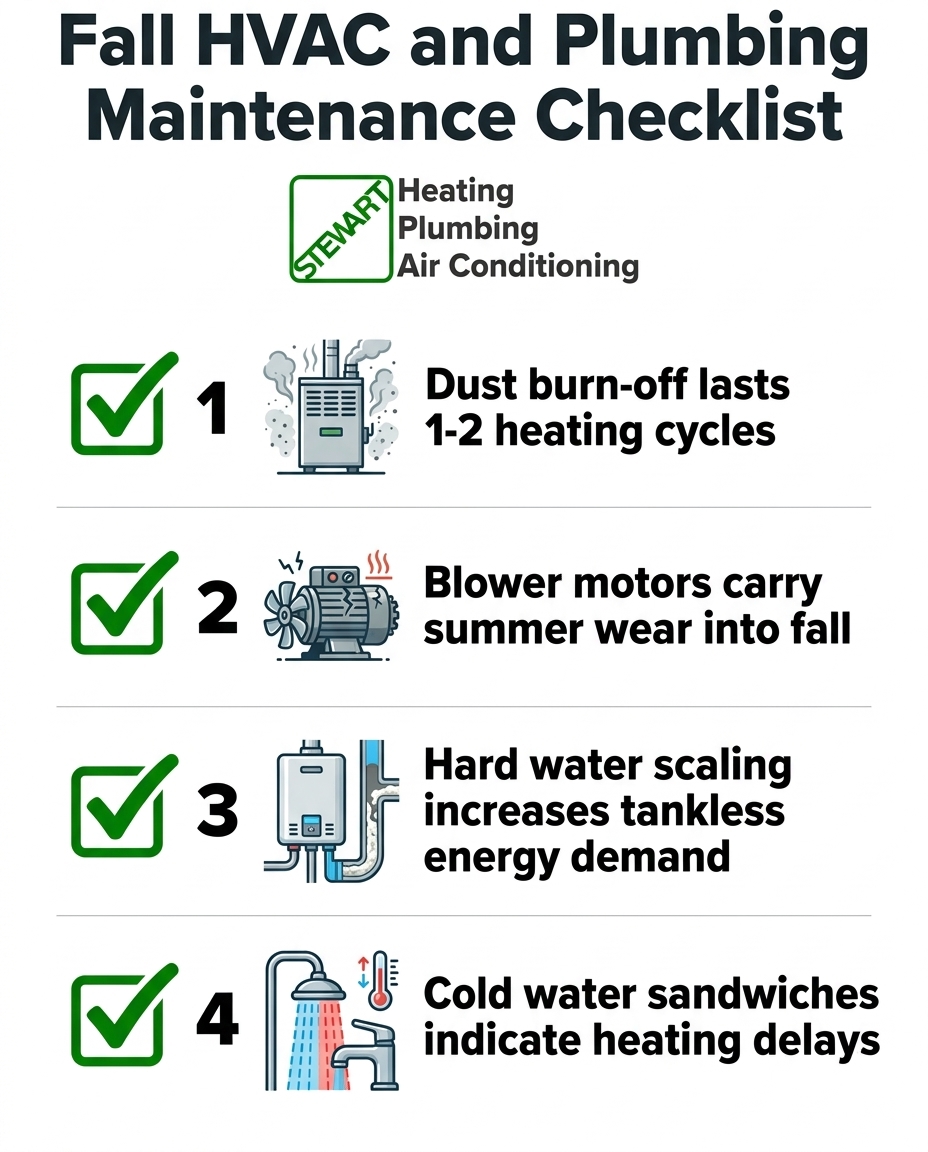
Your heater smells like burning dust because microscopic debris settles on the internal heat exchanger during the idle summer months. When you turn the system on for the first time in the fall, the intense heat instantly incinerates these particles. This brief burn-off is completely normal and should dissipate after one or two heating cycles. If the smell persists or changes to an electrical or plastic odor, turn the system off and call a professional immediately.
The most common problems with tankless water heaters in winter revolve around the increased demand caused by dropping municipal water temperatures. Systems often struggle with ignition failures, display error codes due to restricted venting, or suffer from severe efficiency drops caused by hard water scaling. Because the unit must work much harder to heat freezing incoming water, any existing mineral buildup will heavily restrict its performance during the colder months.
Preparing your HVAC system for fall starts with replacing your air filter to ensure unrestricted airflow for the blower motor. Next, clear any debris, leaves, or overgrown landscaping away from your outdoor exhaust vents and intake pipes. Finally, the most critical step is scheduling a comprehensive pre-winter inspection with a licensed technician to evaluate the electrical connections, test the gas pressure, and verify the safety of the heat exchanger.
A tankless water heater should typically be professionally descaled once a year to maintain optimal performance. However, in regions like the East Bay / Pittsburgh CA that are known for having particularly hard water, you may need to schedule a flush every six to nine months. Regular descaling removes the insulating mineral buildup from the heat exchanger, preventing error codes and extending the overall lifespan of the unit.
A cold water sandwich occurs due to a brief mechanical delay when the system detects water flow and ignites the burner. If you turn the hot water off and quickly turn it back on, the water already in the pipes is warm, but the flow sensor takes a few seconds to fire the burner for the new incoming water. This creates a short gap of unheated water traveling through the line, which feels like a sudden blast of freezing water in the middle of your shower.
Successfully navigating the seasonal transition requires more than just flipping a switch on your thermostat. Understanding the difference between normal operational quirks—like a brief dust burn-off—and actual mechanical hazards is the key to a stress-free entry into the heating season. Recognizing that your blower motor carries wear from the summer, and that your tankless heater faces increased demands from dropping water temperatures, empowers you to make smart maintenance decisions.
If you encounter persistent electrical odors, recurring tankless error codes, or severe cold water sandwiches during those first chilly October nights, professional attention is the best way to secure your winter comfort. Proactive preparation prevents minor seasonal adjustments from turning into mid-winter emergencies. To ensure every component of your home is ready for the cold weather ahead, explore our comprehensive plumbing services and schedule your pre-winter inspection today. You deserve the peace of mind that comes from knowing your home is safe, efficient, and fully prepared.

Very professional and complete. I would recommend Stewart to anyone. Highest quality of workmanship and clean installation.
Stewart Heating Plumbing Air Conditioning just did some work for us for the first time. They did an installation at my home and it turned out well. I thought the price was fair and I definitely would use them again. The technicians were very friendly and knowledgeable about their work. I highly recommend Stewart Heating Plumbing Air Conditioning and already told friends to use them.
We have been using Stewart Heating Plumbing Air Conditioning since 1995. They put the original heating and air unit in the house, and we have just stayed with them. They are dependable and honest people, and they have done a good job for us every time that we have used them!
They came and did an inspection and are coming tomorrow to do the repair.
They replaced a regulator the first time, and then the water heater vent had to be replaced. They did great work.
The gentleman that serviced us was helpful, insightful, and knew what he was talking about. Overall, it was a great experience.