

Recent Blogs
Stay updated with our latest blog posts.


Are you already waking up with dry sinuses, itchy skin, and the sudden snap of static electricity every time you touch a doorknob? Exploring whole home humidifier benefits usually begins with this exact frustration as the weather cools down. During the November pre-winter heating season, indoor air undergoes a drastic change. As furnaces and heat pumps kick on to combat the evening chill, the air inside your living spaces is stripped of its natural moisture, leaving you in a surprisingly arid environment.
The common reflex for most homeowners is to head to the local big-box store and purchase multiple portable humidifiers for different bedrooms. While this seems like a quick and affordable fix, it introduces a new set of problems. You suddenly find yourself managing a daily chore of carrying heavy, sloshing water jugs, cleaning out small plastic tanks, and dealing with uneven moisture levels across the house. The core decision point comes down to this: continuing the ongoing, messy chore of refilling portable tanks, or opting for the seamless integration of a whole-home system.
At Stewart Heating, Plumbing and Air Conditioning, our technicians consistently recommend treating the entire home's air supply directly at the source. Instead of trying to manage the climate room by room with temporary devices, a comprehensive approach ensures that every square foot of your living space receives balanced, healthy moisture. Upgrading your residential indoor comfort means moving away from reactive, high-maintenance appliances and toward integrated systems that work silently in the background.
To understand why indoor air becomes so uncomfortably dry during the heating season, it is helpful to look at the mechanics of relative humidity. Relative humidity measures how much moisture the air is currently holding compared to the maximum amount of moisture it could hold at that specific temperature. Cold air cannot hold as much water vapor as warm air. When you take cold outdoor air and heat it up inside your home, its capacity to hold moisture expands dramatically, but the actual amount of water vapor remains the same. As a result, the relative humidity percentage plummets.
In our decades of experience serving the East Bay and Pittsburg area, our team has found that the constant running of indoor heating systems is the primary culprit behind dry indoor air. Every time your furnace or heat pump cycles on, it circulates warm, dry air through your ductwork. This heated air acts like a sponge, pulling moisture out of everything it touches—including your skin, your respiratory system, and the physical structure of your house. Maintaining an optimal 30-50% indoor humidity level becomes nearly impossible when the heating equipment is actively working against it.
True comfort requires addressing the air circulating through the ductwork, not just placing a band-aid on isolated rooms. When moisture is introduced directly into the airflow immediately after it leaves your home heating systems, the conditioned air is already balanced before it ever reaches your living room or bedrooms. This foundational approach to humidity management ensures that your respiratory health and overall physical comfort are protected consistently, regardless of how often the heating equipment needs to run to keep the house warm.
When we visit homes for late fall tune-ups, homeowners often share their frustrations with portable units. While these devices serve a purpose in a pinch, relying on them for an entire season quickly reveals their limitations. The drawbacks of portable units extend far beyond their limited coverage area, creating a significant amount of manual labor and introducing hidden indoor air quality risks.
• Daily maintenance fatigue: Keeping just two or three portable humidifiers running requires constant attention. You are forced into a daily routine of unplugging units, carrying heavy, dripping water tanks to the sink or bathtub, and trying to fill them without spilling water on your floors. During the peak of the November pre-winter heating season, these small tanks often run dry in the middle of the night, waking you up with a flashing red light or a sudden drop in room comfort.
• Uneven and localized comfort: Portable units are only designed to treat a very small radius. If you place one in the corner of a bedroom, that specific corner might reach a comfortable humidity level, but the moisture rarely makes it out into the hallway, the living room, or the kitchen. This creates distinct micro-climates in your home, where you experience dry air the moment you step out of the treated zone.
• Hidden mold and bacteria risks: Perhaps the most concerning drawback is what happens inside those plastic water tanks. Stagnant water sitting in a warm room is a breeding ground for biological growth. If portable humidifier tanks are not meticulously scrubbed with vinegar or bleach solutions every few days, they can easily harbor mold, mildew, and bacteria. When the unit is turned on, these contaminants are aerosolized and blown directly into the air you breathe.
• White mineral dust accumulation: Many ultrasonic portable humidifiers lack proper filtration. If you fill them with standard tap water, the unit will disperse the natural minerals found in the water into the air. This often settles as a fine white dust on your furniture, electronics, and flooring, creating an entirely new cleaning chore.
Ultimately, portable units are a temporary, high-effort fix rather than a permanent home improvement. They demand your time and attention daily, and if neglected, they can actively degrade your indoor air quality.
Transitioning to an integrated system fundamentally changes how your house feels during the colder months. The advantages of a whole-home solution span across health, physical comfort, and even the operational efficiency of your heating equipment.
1. Consistent, balanced moisture for health: When your home maintains an optimal 30-50% indoor humidity level, your body notices the difference immediately. Proper moisture levels prevent the mucous membranes in your nose and throat from drying out, which is a common trigger for sinus irritation and respiratory discomfort. Furthermore, properly humidified air prevents the skin from losing its natural oils, significantly reducing the itchiness and flakiness associated with winter weather.
2. Improved energy efficiency and perceived warmth: One of the most fascinating benefits of proper humidity is its effect on how temperature feels to the human body. Dry air evaporates moisture from your skin rapidly, which creates a cooling effect—much like how a breeze cools you down in the summer. When the air has adequate moisture, this evaporation slows down, making you feel warmer. This allows homeowners to comfortably lower their thermostat by a few degrees without sacrificing comfort, effectively reducing the workload on the heating system.
3. Elimination of static electricity shocks: Static electricity thrives in overly dry environments. The sudden, painful shocks you get from touching a light switch, a pet, or a family member are a direct result of low humidity. By introducing consistent moisture into the air, a whole-home system naturally dissipates these static charges, making your home a much more comfortable place to navigate.
4. Passive, automatic operation: The greatest relief for most homeowners is the complete elimination of daily chores. Once installed, an integrated system works completely automatically in tandem with your HVAC equipment. There are no tanks to fill, no heavy jugs to carry, and no daily scrubbing required. It is a true "set it and forget it" solution for enhancing indoor air quality in Pittsburg.
Beyond human comfort, one of the most valuable yet lesser-known benefits of whole-home humidification is its ability to protect the physical structure and furnishings of your home. Wood is a hygroscopic material, meaning it naturally absorbs and releases moisture depending on the environment around it.
The mechanics of moisture loss: When indoor air becomes excessively dry, it acts like a vacuum, pulling moisture out of every porous material in the house. This includes your expensive hardwood floors, wooden window frames, antique furniture, cabinetry, and even musical instruments like pianos or acoustic guitars. As the wood loses moisture, it shrinks.
The risk of structural damage: This shrinking process is rarely uniform. As hardwood floors contract, unsightly gaps can appear between the planks. Wooden furniture can begin to warp, and the joints holding chairs and tables together can loosen and eventually crack. Pianos fall out of tune much faster in dry environments because the soundboard shrinks and alters the tension on the strings. Over multiple winter seasons, this constant cycle of expanding in the summer and shrinking in the winter causes permanent, cumulative damage to your interior investments.
House-wide protection: Maintaining an optimal 30-50% indoor humidity level acts as a structural safeguard. By keeping the moisture content of the air stable, the wood in your home remains dimensionally stable as well. This level of comprehensive protection is simply impossible to achieve with portable units, which leave the vast majority of your home's flooring and woodwork completely untreated and vulnerable to the dry air.
Understanding how a whole-home system actually works helps demystify the installation process and highlights its low-maintenance appeal. Unlike a standalone appliance, an integrated humidifier becomes a permanent extension of your existing heating and cooling infrastructure.
A whole-home humidifier is mounted directly onto the supply or return ductwork of your central heating system. It is also tapped directly into your home's plumbing system, providing it with a continuous, automated water supply. Inside the unit is a water panel (sometimes called an evaporator pad). When the system calls for humidity, water flows over this panel. As the warm air from your furnace passes through the saturated pad, it absorbs the moisture as a vapor and distributes it evenly throughout the entire house via the duct network.
Just as a thermostat monitors and controls your home's temperature, a whole-home humidifier is controlled by a humidistat. This device constantly monitors the moisture levels in the air. When the humidity drops below your set preference during the November pre-winter heating season, the humidistat signals the humidifier to turn on. Once the target level is reached, it shuts off automatically. This precise control prevents the home from ever becoming too dry or too damp.
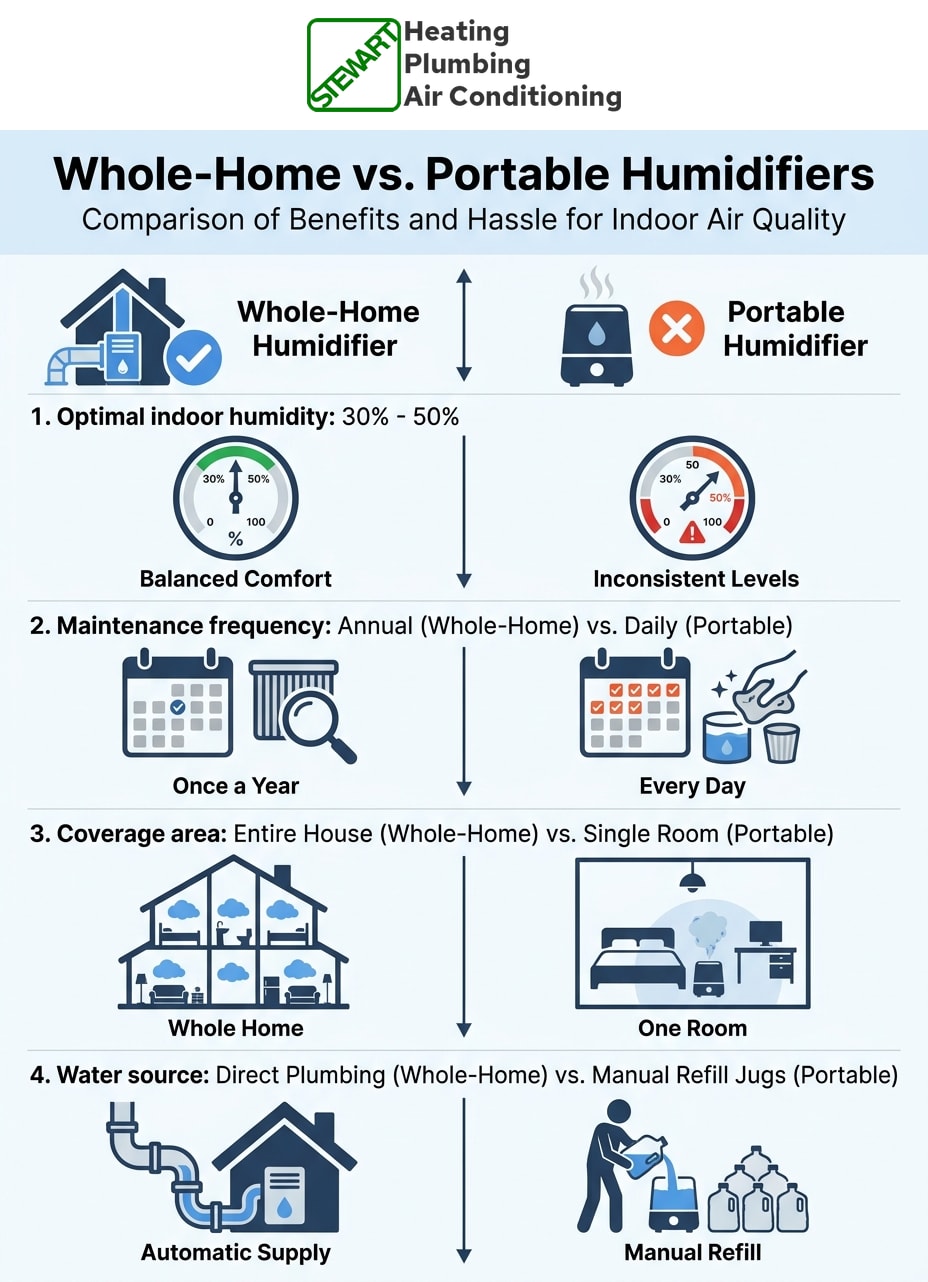
• Water Supply — Whole-Home Humidifier: Directly plumbed; fills automatically — Portable Room Humidifier: Manual refill; requires carrying heavy jugs daily
• Coverage Area — Whole-Home Humidifier: Entire home via existing ductwork — Portable Room Humidifier: Single room or small localized radius
• Maintenance Frequency — Whole-Home Humidifier: Annual water panel replacement — Portable Room Humidifier: Daily tank rinsing and weekly deep cleaning
• Mold Risk — Whole-Home Humidifier: Very low (continuous fresh water flow) — Portable Room Humidifier: High (stagnant water sitting in warm rooms)
• Control Mechanism — Whole-Home Humidifier: Automatic humidistat monitoring — Portable Room Humidifier: Manual dials; often runs until empty
Because tapping into your home's ductwork and plumbing requires precision, installation must be performed by a licensed professional. As a family-owned business serving Contra Costa County since 1974, our installers at Stewart Heating, Plumbing and Air Conditioning ensure your system is sized correctly and operates safely. Once installed, the only maintenance typically required is a simple pad replacement, which our technicians can easily handle during your annual HVAC maintenance agreement visit.
Yes, whole house humidifiers are widely considered a worthwhile investment for long-term home comfort. They provide consistent, house-wide moisture that protects your respiratory health and preserves expensive woodwork and hardwood floors. Most importantly, they completely eliminate the daily manual labor and mess associated with refilling and cleaning portable humidifier tanks.
Not when they are professionally installed and maintained properly. Because integrated systems use a continuous flow of fresh water from your home's plumbing and distribute moisture as a fine vapor through the ductwork, they are actually far less prone to localized mold than neglected portable water tanks. Maintaining an optimal 30-50% indoor humidity level ensures the air is comfortable without being damp enough to support biological growth.
The primary pros include automatic operation, comprehensive whole-house coverage, and improved energy efficiency since properly humidified air feels warmer on the skin. The main cons are that the system requires an upfront investment for the equipment and it must be installed by a licensed HVAC professional, as it requires modifications to both your ductwork and plumbing.
Yes, for long-term convenience and even distribution of moisture, an integrated system is vastly superior. Portable units are only effective for single, closed-off rooms and require constant daily attention. A whole-house system treats every room connected to your ductwork simultaneously without any daily intervention from the homeowner.
They require minimal maintenance, typically just a single annual service check. This usually involves replacing the water panel or evaporator pad and ensuring the drain line is clear. This once-a-year task is far less labor-intensive than the daily scrubbing, rinsing, and refilling needed to keep portable units safe and operational.
Yes, maintaining proper indoor humidity can help optimize your heating efficiency. Because properly humidified air slows the evaporation of moisture from your skin, it actually feels warmer to the human body than dry air at the exact same temperature. This allows homeowners to comfortably lower their thermostat by a few degrees, which reduces the overall workload on the heating equipment.
A clear, objective understanding of HVAC integration reveals exactly how whole-home systems solve dry air house-wide. By treating the air directly at the source, you can completely eliminate the daily chores, the uneven micro-climates, and the hidden mold risks associated with portable room units. As the November pre-winter heating season approaches, there is no need to settle for dry sinuses, static shocks, or cracking hardwood floors.
Our team at Stewart Heating, Plumbing and Air Conditioning encourages homeowners to explore professional indoor air quality options before the coldest weather sets in and the heating system begins running around the clock. Taking a proactive approach ensures your home remains a healthy, balanced environment all season long. If you are ready to stop carrying water jugs and start enjoying true, automated comfort, take the time to learn more about comprehensive indoor air quality solutions designed for your specific HVAC system.

Very professional and complete. I would recommend Stewart to anyone. Highest quality of workmanship and clean installation.
Stewart Heating Plumbing Air Conditioning just did some work for us for the first time. They did an installation at my home and it turned out well. I thought the price was fair and I definitely would use them again. The technicians were very friendly and knowledgeable about their work. I highly recommend Stewart Heating Plumbing Air Conditioning and already told friends to use them.
We have been using Stewart Heating Plumbing Air Conditioning since 1995. They put the original heating and air unit in the house, and we have just stayed with them. They are dependable and honest people, and they have done a good job for us every time that we have used them!
They came and did an inspection and are coming tomorrow to do the repair.
They replaced a regulator the first time, and then the water heater vent had to be replaced. They did great work.
The gentleman that serviced us was helpful, insightful, and knew what he was talking about. Overall, it was a great experience.