

Recent Blogs
Stay updated with our latest blog posts.

At Stewart Heating, Plumbing and Air Conditioning, helping Pittsburg homeowners find the optimal winter thermostat settings often starts with addressing a frustrating realization: turning your system completely off while you are at work might actually be costing you more energy than it saves. You walk through the front door after a long commute, and your house feels like an icebox. You immediately walk over to the wall, crank the heat up, and then listen as your equipment runs continuously for hours just to make the living room bearable.
Our technicians frequently speak with homeowners who mistakenly believe that drastically lowering their thermostat before leaving for work is the smartest way to conserve energy. On paper, it makes sense. If you are not home, why pay to heat the space? However, this logic ignores the reality of November pre-winter temperature drops. During this time of year, we often experience mild, pleasant days that rapidly give way to sharply chilly evenings. When your home sits without heat for eight to ten hours, the internal temperature plummets.
Turning the system completely off, or setting it back too far, creates a massive temperature deficit inside your home. It is not just the air that gets cold; your walls, floors, and furniture lose their retained heat as well. The ultimate decision point for any homeowner is finding the perfect balance between daytime energy savings and efficient evening recovery. To achieve this, you need a strategy that works in harmony with modern heating systems, rather than fighting against their mechanical design.
The Problem: When you allow your home's temperature to drop significantly during the day, you force your equipment into what our industry professionals call the "recovery phase." This is the period when the unit must work continuously, without cycling off, to bring the house back to your desired comfort level.
The Cause: A common misconception we hear is that turning the thermostat up to 80 degrees will make the house heat up faster than setting it to 70 degrees. Furnaces and heat pumps do not have a "fast" setting. They operate at a consistent output. When you demand a massive temperature increase, the system does not blow hotter air; it simply runs longer at full capacity. This extended, high-intensity recovery cycle consumes a tremendous amount of energy. In many cases, the energy you thought you saved during your eight-hour work day is entirely wiped out by the sheer effort required to reheat a freezing house.
The Solution: The key to managing this phase effectively is preventing the temperature deficit from getting too large in the first place. This is especially true for homes dealing with Pittsburg and East Bay microclimates, where evening temperatures can drop suddenly and sharply as the sun goes down. A well-managed thermostat strategy prevents the system from having to climb a steep temperature mountain every single evening.
Our team sees the effects of poorly managed recovery phases all the time. One local homeowner experienced this firsthand during a sudden late-fall chill. They reached out to Stewart Heating, Plumbing and Air Conditioning for help when a malfunctioning circuit board in their heating unit failed completely after running non-stop. After fixing the problem quickly and explaining the cause of the electrical strain, our technician recommended a better scheduling strategy and successfully set up smart thermostat upgrades to automate the process. By managing the recovery phase intelligently, you protect your equipment from unnecessary wear and tear.
The U.S. Department of Energy generally recommends setting your thermostat to 68 degrees when you are awake and at home. For the hours you are away, their generic national advice often suggests lowering the temperature by 10 to 15 degrees. While that might work in certain parts of the country, local realities require a more tailored approach. Based on our extensive experience in the East Bay, our team recommends a 5 to 8 degree maximum setback as the true sweet spot for balancing comfort and efficiency.
Here is how we advise applying the 5 to 8 degree rule effectively:
1. Determine your baseline comfort level: If you are comfortable at 68 degrees while watching television in the evening, this is your baseline.
2. Calculate your maximum setback: Subtract no more than 5 to 8 degrees from your baseline. If your baseline is 68, your "away" temperature should never drop below 60 to 63 degrees.
3. Protect your thermal mass: By keeping the temperature drop within this tight window, you prevent your home's thermal mass—the drywall, hardwood floors, heavy furniture, and cabinetry—from freezing. When your thermal mass stays relatively warm, the air heats up much faster when the system kicks back on.
4. Ensure a smooth recovery: A 5-degree temperature gap takes significantly less time and energy to close than a 15-degree gap, allowing your equipment to recover smoothly without overworking.
If you are interested in learning more about adjusting your system for the changing seasons, transitioning your thermostat settings for fall and winter is a great place to start. Maintaining a tighter temperature window is the secret to lower utility bills and a more comfortable living environment.
• Thermal Mass Heat Loss — Generic 10+ Degree Setback: Severe. Furniture and walls become cold to the touch. — The 5 to 8 Degree Local Rule: Minimal. Home retains baseline warmth throughout the day.
• Recovery Phase Duration — Generic 10+ Degree Setback: 1 to 3 hours of continuous, non-stop operation. — The 5 to 8 Degree Local Rule: 20 to 45 minutes of normal cycling.
• Equipment Strain — Generic 10+ Degree Setback: High risk of overheating components and blower motor fatigue. — The 5 to 8 Degree Local Rule: Low risk. Operates within normal design parameters.
• Perceived Comfort — Generic 10+ Degree Setback: Drafty and cold upon returning home. — The 5 to 8 Degree Local Rule: Consistently comfortable within minutes of arrival.
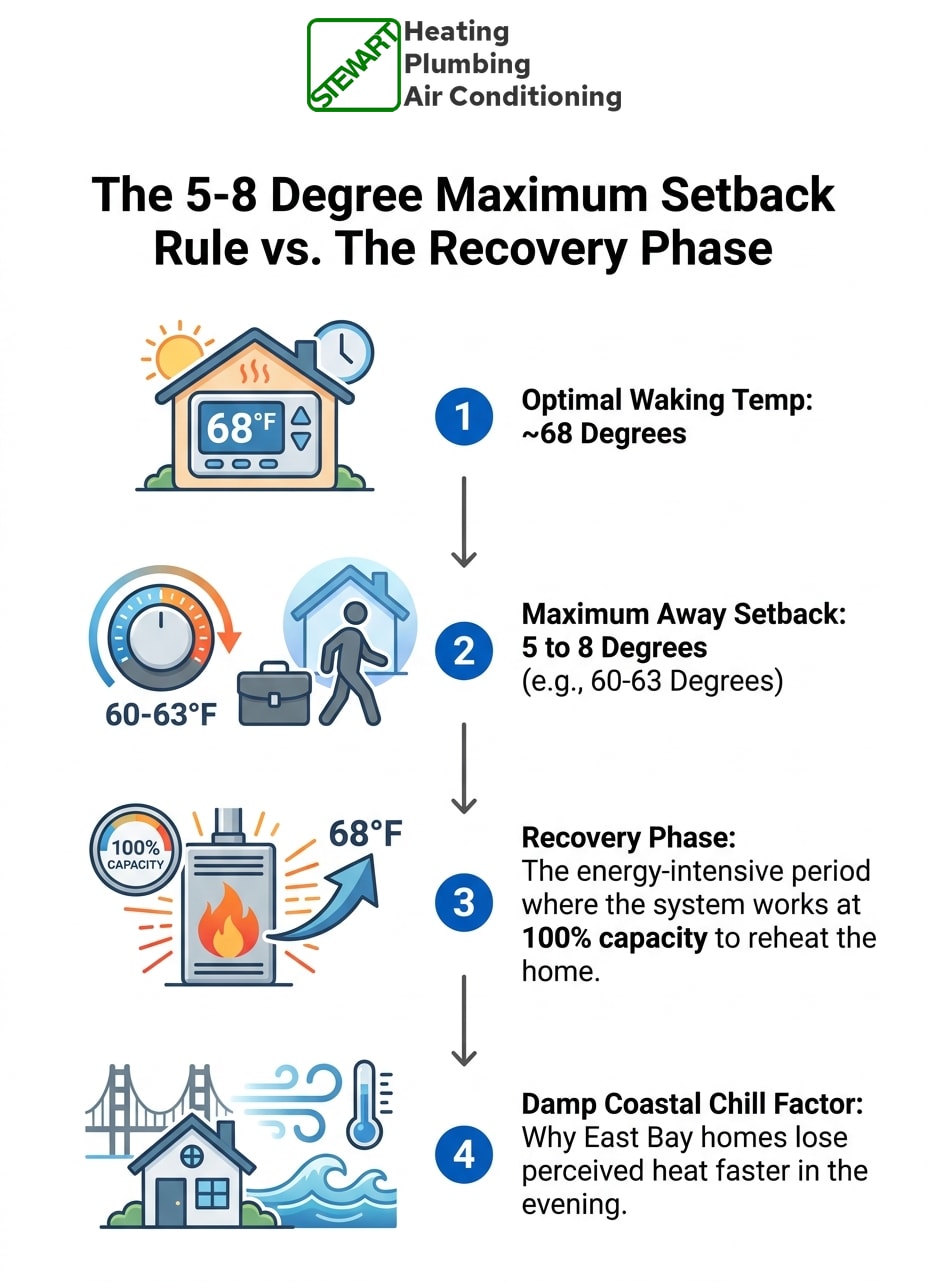
If you live in the Midwest, a dry, freezing winter day behaves very differently than late fall weather in Northern California. In our decades of serving the area, we've found that the Pittsburg and East Bay microclimates present a unique set of challenges for indoor comfort. Here, we frequently experience a damp coastal evening chill in the Delta region, which forces HVAC systems to work significantly harder during the recovery phase compared to dry cold climates.
Damp air simply feels colder than dry air at the exact same temperature. Moisture in the air acts as a highly efficient conductor, pulling heat away from your skin much faster than dry air. When your home sits empty during a deep daytime setback, this damp chill slowly penetrates the building envelope. It seeps into the drywall, settles into the carpets, and cools the ambient air.
The result: When your system finally turns on at 5:30 p.m., it is not just heating the air; it is actively fighting against a heavy, moisture-laden chill. It takes considerably more energy to heat damp air than it does to heat dry air. This is exactly why generic national thermostat advice fails in our specific regional environment. A 15-degree setback in a dry climate might be manageable, but attempting that same setback against a damp Delta breeze will leave your furnace running endlessly into the night.
Knowing the 5 to 8 degree rule is only half the battle; applying it consistently is what actually lowers your energy usage. Manually adjusting the dial every time you leave the house is tedious, and humans are notoriously forgetful. This is why our technicians always emphasize that programmable schedules are your best tool for managing comfort.
Here is a sample daily schedule we often set up for our customers, designed around the 5 to 8 degree maximum setback:
1. 6:00 AM (Waking up): System targets 68 degrees. Schedule this to begin 30 minutes before your alarm goes off so the house is warm when your feet hit the floor.
2. 8:00 AM (Leaving for work): System drops to 62 degrees. This is your safe setback temperature that protects thermal mass.
3. 4:30 PM (Pre-arrival recovery): System begins targeting 68 degrees. By scheduling the recovery phase 30 to 45 minutes before you walk through the door, you avoid the urge to manually crank the heat up to 75 degrees in frustration.
4. 10:30 PM (Sleeping): System drops back to 62 or 64 degrees. Sleeping in a cooler environment is generally more comfortable and saves energy overnight.
During a recent pre-winter service call, our installation team helped a local family with a complete heater replacement. Once the new system was secured in place, our technician took the time to instruct the homeowners on its operation and exactly how to program their new thermostat for their daily 9-to-5 routine. Leaving the area clean and the system perfectly calibrated, we ensured the family would not accidentally overwork their brand-new equipment.
Keep in mind that even the best thermostat schedule relies on your home's ability to hold onto the heat it generates. Exploring home energy efficiency upgrades, such as proper weatherstripping and attic insulation, will maximize the effectiveness of your daily schedules by keeping the damp chill outside where it belongs.
The Problem: Ignoring the 5 to 8 degree rule does more than just inflate your energy usage; it actively shortens the lifespan of your mechanical equipment. When you force a system into continuous, heavy recovery cycles day after day, you accelerate the wear on every moving part inside the cabinet.
The Cause: A furnace is designed to cycle on, reach the target temperature, and cycle off to rest. When you demand a 15-degree temperature swing during November pre-winter temperature drops, the blower motor and heat exchanger are forced to run non-stop for hours. This constant friction and heat generation can lead to overheating components, strained capacitors, and a stressed blower motor.
The Solution: Preventing this strain requires a combination of smart thermostat management and professional oversight. For example, during a recent fall appointment, a homeowner hired us to install a completely new furnace. Our team completed the installation cleanly and made sure to thoroughly explain the new thermostat operations, ensuring the homeowner understood how to avoid straining the new equipment with extreme daytime temperature swings. To keep your system resilient against seasonal transitions, investing in routine heating maintenance is the best way to catch wear and tear before it turns into a mid-season breakdown.
National averages and generic energy tips look great on a blog post, but they simply do not account for local housing construction or the specific nuances of our weather patterns. Understanding exactly how local homes retain and lose heat is critical to establishing the right thermostat settings for your family.
Many homes in our area were built in eras with different insulation standards. A house built in the 1970s will lose its thermal mass much faster than a newly constructed property. As a company serving the area since 1974, Stewart Heating, Plumbing and Air Conditioning leverages over 50 years of local experience. This gives us a highly practical understanding of how Pittsburg and East Bay microclimates interact with these older building envelopes. We know firsthand that a one-size-fits-all approach leaves homeowners either shivering in the evening or paying exorbitant utility bills.
We encourage homeowners to look beyond generic advice. Adopt strategies suited to your specific environment. Acknowledge the damp chill, respect your home's thermal mass, and use the 5 to 8 degree rule to your advantage.
At Stewart Heating, Plumbing and Air Conditioning, we generally recommend a winter setting of 68 degrees Fahrenheit while you are awake and at home. This temperature provides a comfortable baseline for most families while keeping energy usage in check. If 68 degrees feels a bit too chilly, try wearing a sweater or using a throw blanket before bumping the dial up to 70 or 72, as every degree higher significantly increases your energy consumption.
Yes, our technicians find it is generally cheaper to leave your heating on a low, steady setback rather than turning it completely off. Following the 5 to 8 degree maximum setback rule ensures your home's thermal mass does not freeze. Turning the system entirely off forces it to run continuously for hours to recover the lost heat, which ultimately consumes more energy than maintaining a modest baseline temperature.
You should lower your thermostat by no more than 5 to 8 degrees when you leave for work. Dropping the temperature any lower than this creates a massive deficit that strains your equipment during the recovery phase. Keeping the setback within this tight window balances energy savings with a smooth, efficient reheating process when you return.
For optimal sleep and energy savings, setting your thermostat between 60 and 64 degrees at night is ideal. The human body naturally prefers a cooler environment for deep sleep. By utilizing heavy blankets and a lower ambient temperature, you give your heating system a break during the coldest hours of the night.
If your house takes hours to heat up, you are likely dropping the daytime temperature too low, forcing a long recovery phase. As we often see in East Bay homes, it can also indicate that your home lacks proper insulation, allowing the damp coastal chill to penetrate the walls and cool your thermal mass. Adjusting your away temperature to be slightly warmer can drastically reduce this recovery time.
Yes, indirectly. While the low temperature itself does not hurt the furnace, the resulting recovery phase can. Forcing the system to run non-stop for several hours to close a 15-degree gap places immense strain on the blower motor and heat exchanger. Over time, this continuous heavy operation accelerates wear and tear, leading to premature breakdowns.
Navigating November pre-winter temperature drops does not have to mean choosing between a freezing living room and high utility bills. By adopting a clear, regionally appropriate rule of thumb—setting back your thermostat by no more than 5 to 8 degrees—you can perfectly balance comfort and efficiency. Remember that logical scheduling prevents your system from overworking during the evening recovery phase. The team at Stewart Heating, Plumbing and Air Conditioning highly recommends exploring modern programmable options to automate these daily adjustments, giving you a warm welcome home every single evening without the stress of constant manual tinkering.

Very professional and complete. I would recommend Stewart to anyone. Highest quality of workmanship and clean installation.
Stewart Heating Plumbing Air Conditioning just did some work for us for the first time. They did an installation at my home and it turned out well. I thought the price was fair and I definitely would use them again. The technicians were very friendly and knowledgeable about their work. I highly recommend Stewart Heating Plumbing Air Conditioning and already told friends to use them.
We have been using Stewart Heating Plumbing Air Conditioning since 1995. They put the original heating and air unit in the house, and we have just stayed with them. They are dependable and honest people, and they have done a good job for us every time that we have used them!
They came and did an inspection and are coming tomorrow to do the repair.
They replaced a regulator the first time, and then the water heater vent had to be replaced. They did great work.
The gentleman that serviced us was helpful, insightful, and knew what he was talking about. Overall, it was a great experience.